

The ICE Transformation: Four Thresholds America Has Already Crossed
When Law Enforcement Becomes a Paramilitary Force

Previously: Part 1 documented Gregory Bovino—the Border Patrol commander with the highest use-of-force ratio in the agency, now recruiting 10,000 new ICE agents.
The Script
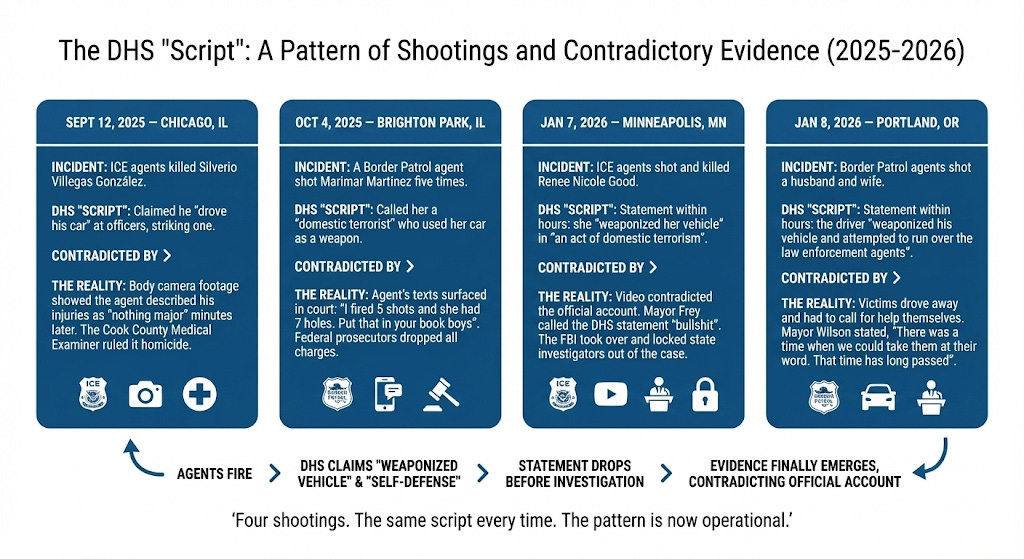
On January 7, 2026, ICE agents shot Renee Nicole Good in Minneapolis. Within hours, DHS released its statement: she had “weaponized her vehicle” in “an act of domestic terrorism.”
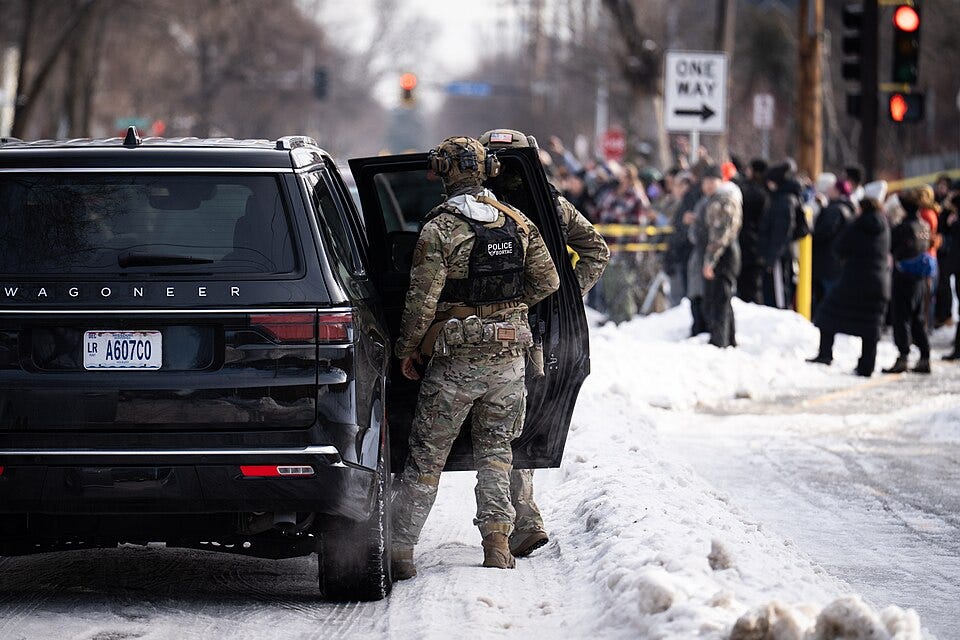
On January 8, Border Patrol agents shot a husband and wife in Portland. Within hours, DHS released its statement: the driver had “weaponized his vehicle and attempted to run over the law enforcement agents.”
The same phrase. The same justification. Two cities. Two shootings. Twenty-four hours apart.
The Chicago Tribune documented the pattern within hours of Good’s death: “Feds’ statements after Minneapolis driver killed by ICE officer echo pattern from Midway Blitz in Chicago.”
On September 12, 2025, ICE agents killed Silverio Villegas González in suburban Franklin Park. DHS claimed he had “refused to follow law enforcement commands and drove his car” at officers, striking one and dragging him “a significant distance.” Body camera footage told a different story: the agent described his injuries as “nothing major” minutes after the shooting. The Cook County Medical Examiner ruled it homicide.
On October 4, 2025, a Border Patrol agent shot Marimar Martinez five times in Brighton Park. DHS called her a “domestic terrorist” who used her car as a weapon. Agent Charles Exum’s texts to colleagues surfaced in court: “I fired 5 shots and she had 7 holes. Put that in your book boys.” In November, federal prosecutors dropped all charges.
Four shootings. The same script every time: agents fire, DHS claims “weaponized vehicle” and “self-defense,” the statement drops before any investigation occurs—and when evidence finally emerges, it contradicts the official account.
Martinez, who survived her shooting, released a statement after Good’s death: “Today’s tragic shooting was all too predictable based on the reckless conduct we have seen ICE officers exhibit in Chicago, Minneapolis and across the country.”
Her attorney, former federal prosecutor Christopher Parente, was blunter: “This is going to keep happening... These agents aren’t trained for this.”
Minneapolis Mayor Jacob Frey reviewed the video and addressed the DHS statement directly: “That is bullshit... To ICE, get the fuck out of Minneapolis.”
Portland Mayor Keith Wilson, one day later: “We know what the federal government says happened here. There was a time when we could take them at their word. That time has long passed.”
This is not a question of whether ICE is being “too aggressive.” This is a question of whether ICE remains a law enforcement agency at all—or whether it has transformed into something else entirely.
The Four Thresholds
There are four markers that distinguish constitutional law enforcement from paramilitary operations. Cross one, and you have a problem. Cross all four, and you have a transformation.
Identification: Agents must identify themselves. Masked operations without badges eliminate accountability.
Profit motive: Enforcement serves public safety, not shareholders. When detention generates private profit, the incentive structure inverts.
Due process: Operations occur within judicial oversight. When people disappear into systems without hearings or legal access, the system has become extrajudicial.
Accountability: Officers serve the Constitution, not a political leader. When loyalty to a person replaces fidelity to law, the agency has become an instrument of power rather than justice.
Minneapolis and Portland just demonstrated what happens when all four thresholds have been crossed. Two cities. Two shootings. One script. No accountability. The template is operational.
When Nobody Can See Your Face
In August 2025, a Colombian immigrant in Los Angeles was livestreaming her morning commute when masked federal agents in an unmarked vehicle pulled alongside her car. They yanked her from the driver’s seat and detained her on the ground while she screamed. No badges were visible. No names were given. No warrant was presented.
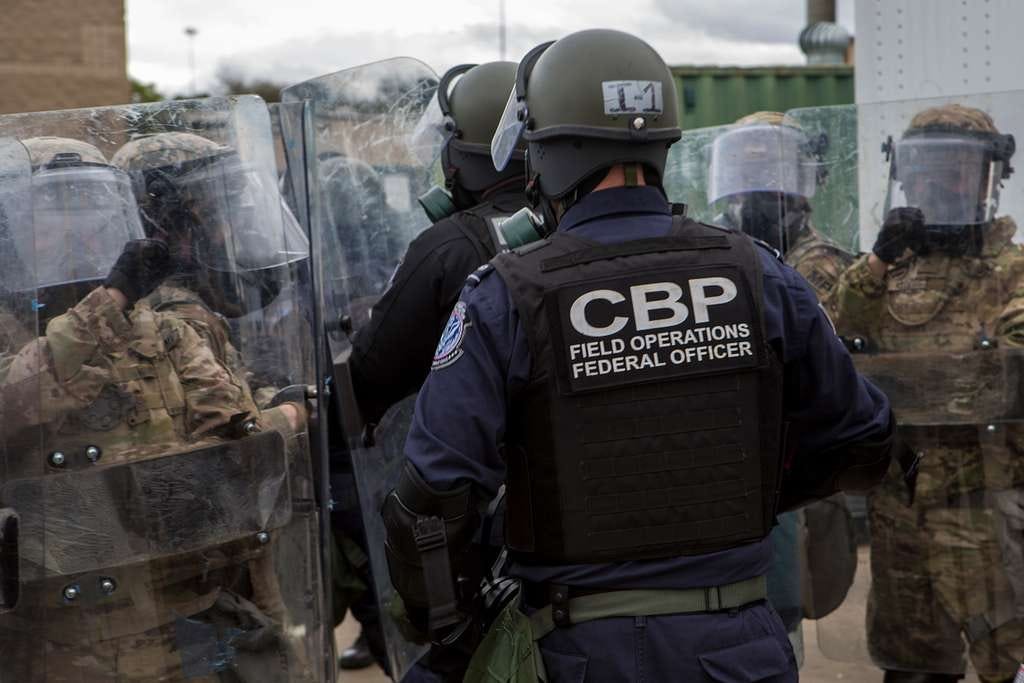
The same month in San Bernardino, masked CBP officers conducting an immigration operation bashed in a vehicle’s window and fired multiple shots at the car. No identification. No accountability.
By September, when Operation Midway Blitz launched in Chicago, Governor Pritzker noted something strange: “camera crews” were arriving alongside federal agents. These weren’t body cameras designed for accountability. They were production teams, there to create content. The raids were being filmed like reality television.
Representative Hank Johnson watched this pattern develop and identified the core problem: when “agents who have masks on” conduct operations, people “don’t know what’s going on, [have] no way to complain or identify or know who even these people really are.”
He’s describing the collapse of constitutional policing’s most basic requirement. You can’t file a complaint against an agent you can’t identify. You can’t sue an officer whose name you never learned. You can’t even verify that the masked men pulling you from your car are actually federal agents rather than criminals impersonating them.
In Minneapolis this week, Renee Good encountered agents in unmarked vehicles who surrounded her car. In Portland, the shooting happened so fast that the victims drove away and had to call for help themselves—dispatch audio captured a man saying ICE agents had shot him and his wife, that he’d been hit in the arm and she’d been hit in the chest.
Constitutional policing has always required identification—not as a courtesy, but as the foundation of accountability. Masked paramilitary operations abandon all of that. And the abandonment isn’t incidental. It’s the point.
When Cruelty Becomes Profitable
In July 2025, Florida officials opened a new immigration detention facility. They named it “Alligator Alcatraz.”
This wasn’t a nickname coined by critics. It was the official name, designed to intimidate. The selling point was that detainees would be surrounded by dangerous wildlife with “nowhere to go, nowhere to hide.”
Human Rights Watch documented the conditions inside facilities like this one. Extreme overcapacity, with people sleeping on concrete floors for weeks. Systematically abusive treatment. Senator Ossoff’s investigation found hundreds of credible reports of physical and sexual assault.
In August, a federal court ordered Alligator Alcatraz closed. But the mentality that created it—detention as punishment, suffering as deterrent—remained fully operational.
Here’s what makes the detention system different from traditional law enforcement: someone profits from every person held.
Private contractors now operate over 90% of ICE detention facilities. CoreCivic and GEO Group, the two largest, are publicly traded companies. Their performance is measured in bodies.
CoreCivic’s CEO, speaking to investors in 2025: “Never in our 42-year company history have we had so much activity and demand.”
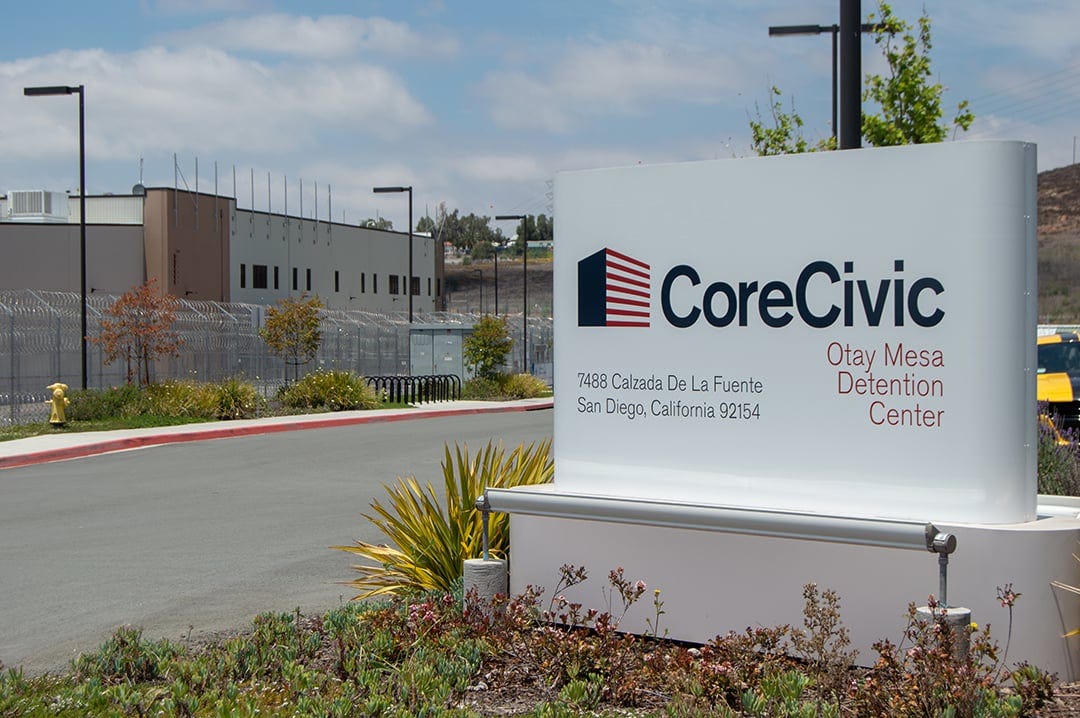
The business model is simple. More arrests mean more detainees. More detainees mean more revenue. More revenue means higher stock prices and bigger executive bonuses. It also means more money for political donations, which means more contracts, which means more detention capacity, which requires more arrests to fill.
The two largest private detention companies donated $2.8 million to Trump’s campaign and inaugural fund. They received billions in no-bid contracts.
CoreCivic’s stock price in January 2025: $12.47 per share. CoreCivic’s stock price in January 2026: $27.83 per share.
That’s a 123% return in twelve months. The product being sold is human suffering.
When People Disappear
The ACLU has documented a pattern that should be impossible in a constitutional system: people held without formal charges, without custody determinations, without any mechanism to contest their detention.
Attorneys arrive at facilities to meet with clients and are turned away without explanation. Families searching ICE’s online detainee locator discover that their relatives simply aren’t listed—vanished from the system’s records while still being held somewhere inside it.
This is what a legal black hole looks like. People enter the system and cease to exist in any way that the law can recognize or reach.
The administration accelerated this process by expanding “expedited removal”—deportation without any hearing before a judge—from a narrow border enforcement tool to something applicable anywhere in the United States. Millions of people are now subject to removal without ever having a chance to make their case.
And when the constitutional system tries to assert oversight, it meets force.
In Newark in 2025, Mayor Ras Baraka was arrested while accompanying members of Congress attempting to conduct oversight of an ICE detention facility. DHS then announced that arrests of sitting Members of Congress were “on the table.”
Twelve House members filed a federal lawsuit documenting systematic denial of facility access. The lawsuit remains pending. The denial continues.
This week, the pattern escalated. In Minneapolis, the FBI took over the investigation of Renee Good’s killing and immediately cut off state investigators. The Minnesota Bureau of Criminal Apprehension announced that the FBI had “reversed course” on a joint investigation—the state “would no longer have access to the case materials, scene evidence or investigative interviews necessary to complete a thorough and independent investigation.”
Minnesota’s state investigators have been locked out of a shooting that happened on Minnesota soil, involving a Minnesota resident, witnessed by Minnesota citizens.
Governor Walz has prepared Minnesota’s 13,000-member National Guard to support local law enforcement. They’re not being prepared to assist federal enforcement. They’re being prepared to protect Minnesota residents’ constitutional rights.
Walz was explicit: “To Minnesotans, on the National Guard, they’re there to protect you and protect your constitutional rights. These are our neighbors. They don’t wear masks. They don’t bust in from somewhere else.”
In Portland, Oregon’s Attorney General saw what happened in Minneapolis and moved immediately. He announced his own investigation into whether federal agents “acted outside the scope of their lawful authority.” Oregon is trying to assert oversight before the FBI can lock them out too.
State versus federal. The constitutional crisis isn’t theoretical anymore.
When Loyalty Replaces Law
As Part 1 of this series documented, the administration has systematically replaced career law enforcement leadership with personnel selected for political loyalty rather than professional competence.
Acting ICE Director Caleb Vitello, with decades of experience, was removed for failing to meet deportation quotas. Madison Sheahan, 28, with zero law enforcement background, was named Deputy Director in direct violation of federal qualification requirements. In May 2025, Stephen Miller demanded massive increases in arrest quotas; veteran officials who couldn’t meet impossible targets were forced into retirement.
Gregory Bovino’s trajectory demonstrates exactly what these criteria select for. His twelve-month escalation from Kern County through Los Angeles, Chicago, and Minneapolis drew federal court findings of constitutional violations, perjury, and conduct that “shocks the conscience”. The result: not discipline but promotion—an invented title (”Commander-at-Large”), direct reporting to Secretary Noem, and command of Operation Metro Surge.
On January 7, 2026, under Bovino’s command, Renee Good was killed.
On January 8, in Portland, Border Patrol agents shot two more people using the same tactics.
Bovino remains in command. The script keeps running.
The Template
This is not about immigration policy. If you don’t care about immigration, this should still concern you.
What’s being established is a template—a proof of concept for how any federal agency can be transformed.
When a federal agency can operate masked units without identification, detain people in deliberately cruel conditions while generating private profits, eliminate due process systematically, and reorganize itself around personal loyalty rather than law—and when it can do all of this without meaningful consequences—that template becomes available for replication.
The FBI. The ATF. The IRS. The DEA.
Pick your least favorite federal agency. Now imagine it operating the way ICE operates today. Masked agents who won’t identify themselves. Detention facilities run by private contractors with quarterly earnings targets. No hearings before an independent judge. No congressional oversight permitted. Loyalty to the president as the primary job qualification.
This is how democratic institutions become authoritarian instruments. Not through dramatic coups, but through systematic transformation that maintains every legal facade while hollowing out the constitutional substance.
Four shootings now follow the same script. Agents fire. DHS claims “weaponized vehicle.” The statement drops before any investigation. Evidence eventually contradicts the official account. No one is held accountable. The operation continues.
Renee Good was a U.S. citizen. A mother of three. A poet. Her family says she had just dropped her son at school. She is dead. DHS calls her a terrorist. Video contradicts their account. Vice President Vance calls her death “a tragedy of her own making.”
In Portland, two more people are in the hospital. DHS used the same script.
Mayor Wilson said it plainly: “There was a time when we could take them at their word. That time has long passed.”
The template is operational. The question is whether anyone can stop it.
Series Navigation
The Gamergate Army Gets Badges and Guns
Part 1: The Hammer: Gregory Bovino’s 12-month escalation across the US
Part 2: The ICE Transformation: Four Thresholds America Has Already Crossed
Part 4: Steve Bannon Saw an Army in Gamergate — And built the bridge to federal power
Part 5: Christchurch to El Paso: 75 Dead in Five Months — When 8chan became terrorism infrastructure
Part 6: Stephen Miller Screamed ‘Quantity Over Quality’ — And built the deportation machine
Part 7: Nick Fuentes Dined at Mar-a-Lago — How Groypers completed the pipeline from chan culture to federal policy
Part 8: Renee Good’s Last Words: ‘I’m Not Mad at You’ — What twenty-two years of radicalization infrastructure killed