

Render Unto Caesar
On July 4, 2025, we stamped the emperor's image on a bill that takes the sick to imprison the stranger.
“Whose likeness and inscription is this?” They said to him, “Caesar’s.” — Mark 12:16
The bill
On July 4, 2025, the President signed a bill on the South Lawn. There were fireworks. There was music. There were cameras. The press called it the One Big Beautiful Bill Act.
Two numbers, next to each other on the same ledger.
The bill cut $911 billion from Medicaid over ten years. The Congressional Budget Office said 11.8 million people would lose their health coverage. The Center for Healthcare Quality and Payment Reform counted 734 rural hospitals at risk of closing. The American Medical Association used the word outrage.
The bill gave $45 billion to build new immigration detention facilities — a 308% increase on an annual basis over ICE’s prior detention budget — and $170.7 billion total to immigration enforcement, routed through budget reconciliation so that it could not be filibustered. Capacity for at least 116,000 beds. The contracts go, overwhelmingly, to private prison companies.
GEO Group posted a record $254 million in profit, up roughly 700% year over year. CoreCivic’s net income rose 69%. GEO Group projects roughly $3 billion in revenue for 2026.
One bill. One signature. One ledger entry.
Extract from the sick. Imprison the stranger. Stamp Caesar’s face on the page and call it Independence Day.
Three faces
Let me show you what this looks like away from the numbers.
Oudone Lothirath was a Laotian refugee who came to the United States as a child in the 1980s. He had terminal Hodgkin’s lymphoma. He had chemotherapy on his calendar. ICE took him from Minnesota in January and flew him 1,300 miles to a tent facility in El Paso, where he slept on a bunk in a large tent and missed multiple rounds of treatment. By the time the agency relented and flew him home, the cancer had spread to his bone marrow. He went into hospice. He had come to this country decades ago. He had a wife. He had children. He had chemotherapy scheduled. Caesar gave him a cot in a tent.
Mark Pieper lives in the Nebraska Panhandle. He needs dialysis to survive — cancer treatment damaged his kidneys. The unit at Chadron Hospital was the only one for miles, and at the end of March 2025 it closed. The hospital was losing a million dollars a year on the service; the critical-access designation that helps rural hospitals stay open does not cover outpatient dialysis. The $219 million in Rural Health Transformation funding the state had just received was not designed to keep existing services running. Pieper now drives an hour and a half to Scottsbluff three times a week — more than nine hours on the road for the machine that keeps him alive. He did not lose coverage in the abstract. He lost his town.
A teacher I know has a brain tumor. She has Parkinsonism. She is not old enough for Medicare. She is not poor enough for Medicaid, in her state. She had the Affordable Care Act. When the enhanced subsidies expired at the end of December, her premium more than doubled — the average increase nationally was 114%. She is one of 22 million people the enhanced subsidies had been reaching.
Three faces. One bill.
The stranger whose chemo was interrupted by the cage. The neighbor whose dialysis was interrupted by the ledger. The teacher whose tumor was interrupted by the premium. Caesar’s image on every page. Their faces on none of them.
The trap
The Gospel of Mark tells the story this way.
The Pharisees and the Herodians come to Jesus together. This is not ordinary. They do not usually cooperate. The Pharisees are scrupulous observers of the Law; the Herodians serve the client king who serves Rome. They are, under most circumstances, enemies. They have come together because they have a shared problem, and that problem is Jesus.
They have designed a question. Is it lawful to pay the tribute to Caesar, or not?
There is no safe answer. If Jesus says yes, the Galilean crowd — ground down by Roman taxes layered on Temple taxes layered on Herod’s taxes — will turn on him. He will have endorsed the extraction that is destroying their families. If he says no, the Romans have him on sedition. Tax refusal is how you get crucified.
The trap is airtight. They have come to watch it snap.
Jesus asks to see the coin. He does not produce one himself. This matters more than we usually allow: Jesus is not carrying a denarius. He has told his disciples to travel the same way — no bag, no money, no second shirt, dependent on the hospitality of the network that is already building itself around him. He operates, by discipline, outside the imperial currency. So he asks them to produce the coin. They have it. He does not.
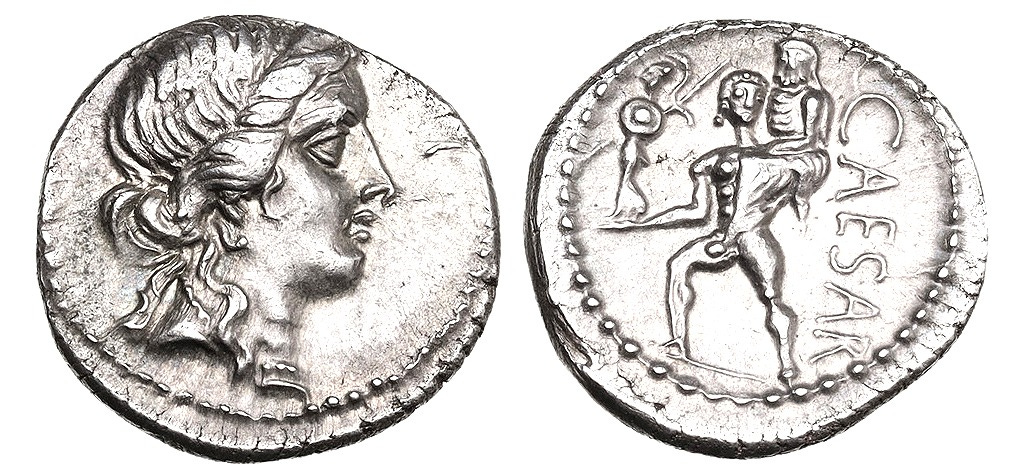
Someone in the crowd hands him a denarius. It bears the image of Tiberius Caesar and the inscription Tiberius Caesar, son of the divine Augustus, high priest. The coin is not a neutral object. The coin is a theological claim. To carry it is to carry, in your pocket, the declaration that a man in Rome is the son of a god.
Jesus holds it up. Whose image is this? Whose inscription?
Caesar’s.
Then he says the sentence we have been mistranslating for two thousand years.
Render to Caesar the things that are Caesar’s. And to God the things that are God’s.
The comma
I was raised inside the tradition that turned this sentence into a permission slip — the white evangelical church that taught me to read. And the trick of the reading is the comma. Not the comma on the page; most translations put an and there. The comma I mean is the one we placed between the two clauses with our breath, the long pause we learned to take in the middle of the sentence so the second half could be heard as a different subject.
We stopped reading at the comma.
That is the whole argument of this essay. That is the whole argument of this series, in one sentence. We stopped reading at the comma.
We were taught — I was taught — that the sentence meant: pay your taxes, obey the authorities, keep your faith private, render what is required and trust that God gets his due in the soul. The two-kingdoms reading. Luther, Calvin, the Reformation. Civil authority sanctified. Spiritual authority spiritualized. Two separate lanes. Caesar in his, God in his. The pause between them a border crossing.
This is not what Jesus said.
Jesus spoke the whole sentence. And the second half — to God the things that are God’s — is the half the whole sentence turns on. Because in the theology of the people who are listening, the question what belongs to God? has a specific and total answer. Everything. The land belongs to God. The harvest belongs to God. The people belong to God. Human beings are made, the first chapter of Genesis says, in the eikon of God — Caesar’s image on the coin, God’s image on the man who holds it.
Walter Wink, in Engaging the Powers, noticed this. The denarius bears Caesar’s image. The human being bears God’s. Render to Caesar what bears his image, and render to God what bears his. The coin is Caesar’s. You are not.
The Zealots in the crowd understand this immediately. The Romans hear a clean answer that does not convict him. The Pharisees hear a dodge and go away angry. The trap has not snapped; it has inverted. Jesus has not told anyone to pay the tax. He has told everyone listening to decide for themselves how much of the world is actually Caesar’s.
The answer Jesus leaves ringing in the silence is this: not much.
We got it wrong in exactly the same way
I was taught Romans 13 before I was taught Romans 12. I was taught the half-verse — the authorities that exist have been instituted by God — and I was taught to read it as a blanket endorsement of whatever government happened to be holding the sword. I was not taught that the chapter just before it tells the church not to be conformed to this world, not to repay evil for evil, to feed its enemies. I was not taught the kingdom of God as the first political speech the Gospel records — only as a destination, a place you arrive at when you die. I was taught the separation of church and state as a Christian virtue, and I was not taught that this “separation” had, in practice, meant rendering almost everything to Caesar and almost nothing to God.
The tradition I inherited stopped reading at the comma. And because we stopped reading at the comma, we never had to ask what belongs to God. And because we never had to ask what belongs to God, we never had to ask what does not belong to Caesar. And because we never had to ask what does not belong to Caesar, we never had to refuse him anything.
Look at the account. We rendered unto Caesar the tax, and Caesar sent it to build cages. We rendered unto Caesar the vote, and Caesar used it to close the dialysis unit. We rendered unto Caesar our neighbors’ health insurance. We rendered unto Caesar our neighbors’ freedom. We rendered unto Caesar the bodies of the poor and the sick and the strangers, and we called it citizenship, and we called it policy, and we called it responsibility, and we called it — God help us — Christian.
This is the second sermon’s charge, and it is aimed first at the church that taught me to read.
The error has a shape, and the shape repeats. Each time the white American church faced a question about who belonged to God and who belonged to Caesar, it answered the same way: by refusing to ask the second half of the sentence. By treating the demand of the state as the whole of the obligation. By calling the people in the cage property or enemy or illegal or unfortunate, and then rendering them — their bodies, their labor, their land, their children — to whatever Caesar was holding the ledger that year. The same failure. The same comma. The same refusal to ask what does not belong to Caesar.
We got it wrong at Nat Turner. We got it wrong at the Trail of Tears. We got it wrong at Tulsa. We got it wrong at internment. We got it wrong at Selma — the white moderate church that King’s Birmingham letter named as the greater obstacle to justice than the Klan. We got it wrong at Central America in the eighties. We got it wrong at the border in 2018. We are getting it wrong now at Chadron, and El Paso, and the kitchen table of the former teacher who cannot afford her premium.
We keep getting it wrong in exactly the same way. We keep stopping at the comma.
What belongs to God
The second half of the sentence is what the series has been about, week by week, since February.
The kingdom of God — the phrase Jesus opens his public ministry with — is a claim about what belongs to God. It is the competing sovereignty. It is the counter-economy. It is the mutual aid network that feeds and shelters and clothes and visits without checking papers and without sorting by jurisdiction. It is, in the sheep-and-goats passage, the single criterion by which the nations are sorted at the end of the age: I was hungry and you fed me, I was sick and you visited me, I was a stranger and you welcomed me.
Not: did you pay your tribute on time. Not: did you respect authority. Not: did you render to Caesar cleanly enough.
Did you feed. Did you visit. Did you welcome.
The sick man in Chadron belongs to God. The dialysis unit that kept him alive belongs to God. The rural hospital belongs to God — not to the CBO score, not to the reconciliation bill, not to the work-requirement flowchart that, the Arkansas experiment showed, takes coverage from the people already doing the work because they cannot navigate the paperwork that proves it.
The chemotherapy patient belongs to God. The tent in El Paso does not. The $45 billion appropriation for cages does not. The 308% increase in detention budget does not. The dividend cut from the body of the stranger and paid out to the shareholder does not. The corporation that houses the stranger for a daily rate paid out of a reconciliation bill paid out of the Medicaid cut paid out of Mark Pieper’s dialysis — that corporation is the money changer. The detention contract is the Temple tax. The cage is the sacred space Jesus walked into with the whip of cords.
The stranger belongs to God. The teacher belongs to God. The refugee belongs to God. The construction worker who paid into the system for twenty years and will now be sorted at a cot in a tent — he belongs to God. The mother whose son is in the cage belongs to God. The child watching her father be taken belongs to God.
The coin has Caesar’s face on it.
They do not.
What rendering looks like
The sentence has never meant what it was taught to mean. It has always been an instruction to look at the image and decide.
In January 2025, the Department of Homeland Security revoked the policy that had kept ICE out of churches, schools, and hospitals — the “sensitive locations” rule. Within weeks, more than 1,500 congregations had declared themselves sanctuary. In February, the Episcopal Church and the Massachusetts Council of Churches and twenty-some other Christian and Jewish bodies sued the federal government in federal court, arguing that the new policy violates the First Amendment. Each of those congregations, in declaring sanctuary, was rendering unto Caesar. They were saying: this much is his, and not one inch further. They were saying: you may have the building code, but you may not have the threshold. They were saying: this house belongs to God.
The nurse who keeps seeing the undocumented patient after the Medicaid ends is rendering unto Caesar. She is saying: you may have the payment, but you may not have the patient. The mutual aid network that feeds the family whose breadwinner is in the cage is rendering unto Caesar. It is saying: you may have the body, but you may not have the household. The congregation that asks whose image is on the bill is rendering unto Caesar. It is saying: we will pay what we owe, and we will owe nothing that is not yours.
The lawyer who takes the detention case for free. The teacher who will not turn in the student. (Last February, a teacher in Baltimore County did the opposite — offered ICE the names of his undocumented students by direct message. The church I am writing to needs to know which kind of teacher it is going to praise on Sunday.) The neighbor who drives to Scottsbluff with the dialysis patient because the unit in Chadron is gone. The doctor who tells the hospital board that closing the maternity ward is not a neutral financial decision. The pastor who stops praying for the troops long enough to pray, out loud, for Oudone Lothirath.
Each of them is rendering unto Caesar. Each of them has drawn the line in a different place than the white evangelical church has been taught to draw it. Each of them has done what the sentence actually asked them to do, which is to ask what bears whose image, and act accordingly.
The close
Jesus holds up the coin. He does not say pay it. He does not say refuse it. He says: look at the image, and decide who you are.
On July 4, 2025, the American government stamped Caesar’s image on a bill that extracts from the sick to imprison the stranger. The bill is sitting on a shelf somewhere in the National Archives now, between the fireworks footage and the signing pen. It has Caesar’s face on every page.
Mark Pieper’s face is not on it.
Oudone Lothirath’s face is not on it.
The teacher’s face is not on it.
Eleven point eight million faces are not on it.
Render unto Caesar the things that are Caesar’s.
And not one thing more.
Sources
GEO Group’s record $254M profit: Common Dreams; American Prospect, “ICE Boosts Income at Private Prison Company GEO Group by 800 Percent”.
CoreCivic FY 2025 net income ($116.5M vs $68.9M, +69%): CoreCivic Q4 and Full Year 2025 Financial Results.
CBO: $911B Medicaid reduction, 11.8M coverage loss: CBPP, “By the Numbers”; KFF, allocating CBO Medicaid spending reductions.
$45B detention appropriation, 308% increase, 116,000+ beds: NILC, “The Anti-Immigrant Policies in Trump’s Final Big Beautiful Bill, Explained”; American Immigration Council fact sheet.
$170.7B total immigration enforcement, reconciliation pathway: American Immigration Council fact sheet; One Big Beautiful Bill Act (Wikipedia).
734 rural hospitals at risk (Center for Healthcare Quality and Payment Reform): Becker’s Hospital Review; CHQPR report (PDF).
Oudone Lothirath, Laotian refugee, ICE detention and missed chemotherapy: Star Tribune, “Detained by ICE, he missed multiple cancer treatments. Now he’s in hospice.”.
Mark Pieper, Chadron dialysis closure, $219M Rural Health Transformation funding: KFF Health News, “Rural Nebraska Dialysis Unit Closes Despite the State’s $219M in Rural Health Funding”; NPR, “They counted on a rural dialysis unit to keep them alive. Then it closed”.
ACA enhanced premium tax credits expiration: 22M affected, 114% average premium increase: KFF, “ACA Marketplace Premium Payments Would More than Double on Average”; KFF interactive premium calculator.
Medicaid work requirements and the Arkansas experience (compliant recipients losing coverage to administrative burden): KFF, “A Closer Look at the Work Requirement Provisions in the 2025 Federal Budget Reconciliation Law”; CBPP, “Medicaid Work Requirements Will Take Away Coverage From Millions”.
AMA’s “outrage” at passage of OBBBA: AMA, “Changes to Medicaid, the ACA and other key provisions of the One Big Beautiful Bill Act”.
January 2025 DHS revocation of “sensitive locations” policy; 1,500+ congregations declaring sanctuary; Episcopal Church / Massachusetts Council of Churches lawsuit (Feb 11, 2025): Christian Science Monitor, “Congregations sue for sanctuary”; NPR, “What it’s like to take sanctuary in a church”.
Overlea High School teacher (Baltimore County) offering names of undocumented students to ICE, February 2025: Maryland Matters, “Students fearful after posts apparently offering to turn undocumented students over to ICE”.
Walter Wink on the denarius and the imago Dei: Engaging the Powers: Discernment and Resistance in a World of Domination (Fortress Press, 1992).
Tip to readers: ICE has been jailing thousands of people nationwide in innocuous -looking buildings with no identifying signage. Scroll in article to large USA map and click on pin for a site near you:
http://coloradotimesrecorder.com/2026/03/exclusive-ice-locks-thousands-including-kids-in-170-hold-rooms-nationwide-here's-where-they-are/77352
Well written. I appreciate the links. I agree with everything written here.
Regarding Romans 13 I would like to add that the martyrs of the early church interpreted this passage as meaning that, when called before the magistrate, they owed them an explanation.