

The UN Said the Epstein Files Represent Crimes Against Humanity. The Same Legal Standard Applies to ICE.
The Rome Statute framework maps onto the detention system element by element.
Previously: The Epstein Files — How the DOJ used victim privacy to protect perpetrators. They Can’t Even Redact a PDF — The botched release.

On January 3, 2026, guards at Camp East Montana compressed Geraldo Lunas Campos’s neck and torso until he stopped breathing. He was 55 years old. He was handcuffed. A fellow detainee heard him say “no puedo respirar” — I cannot breathe — while at least five guards held him down.
The El Paso County Medical Examiner ruled his death a homicide: asphyxia due to neck and torso compression.
ICE sent the next body to a military hospital that doesn’t release autopsy reports. Then it moved to deport the witnesses.
Six weeks later, a panel of UN human rights experts established the legal threshold for crimes against humanity. They were talking about Jeffrey Epstein.
They could have been talking about this.
The UN Standard
On February 18, 2026, the UN panel concluded that the conduct documented in the Epstein files “may reasonably meet the legal threshold of crimes against humanity.” They cited the Rome Statute — specifically, Article 7. They identified four factors: scale, systematic character, transnational reach, and the nature of the acts. They called for prosecution “in all competent national and international courts.”
The experts didn’t use the phrase loosely. They cited a specific legal threshold from international criminal law:
Acts committed “as part of a widespread or systematic attack directed against any civilian population, with knowledge of the attack.”
Under the Rome Statute, qualifying acts include deportation or forcible transfer of population, torture, enforced disappearance, imprisonment or severe deprivation of liberty, persecution against an identifiable group, and other inhumane acts causing great suffering.
The experts found that Epstein’s operation — targeting women and girls across multiple countries through an organized criminal enterprise — met this threshold.
They were describing one population.
There is another.
The Scale
The Epstein files document over 1,200 identified victims across multiple countries over decades. Three million pages of evidence. A transnational criminal enterprise operating through wealth and concealment.
The ICE/CBP operation dwarfs it.
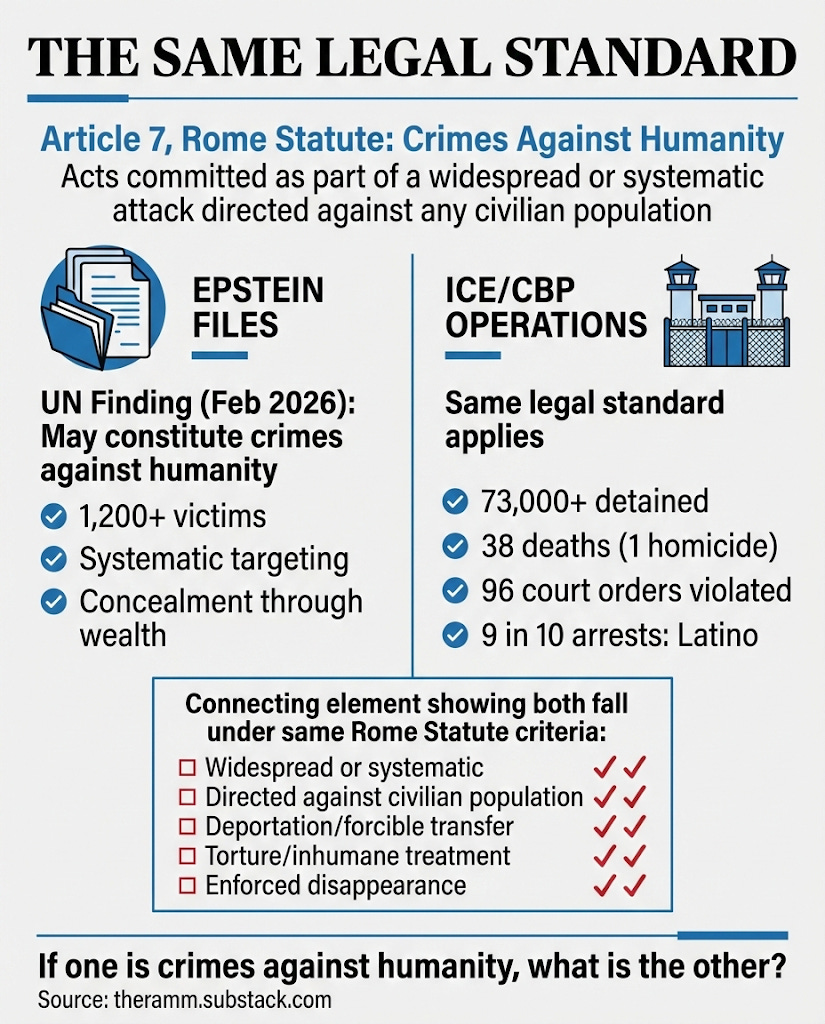
In the thirteen months since January 2025: 73,000+ people held in detention at any given time — the highest in history. Hundreds of thousands deported. At least 32 deaths in ICE custody in 2025 alone — nearly tripling the 11 deaths in 2024 and the highest since 2004 — plus at least 6 more in January 2026. Ninety-six court order violations documented in a single month. Operations across all 50 states. Deportations to dozens of countries, including third countries where deportees have no citizenship. A 135,000-bed detention infrastructure planned by 2029.
The Epstein operation required concealment for decades. The ICE operation has a $165 billion budget and congressional authorization.
The UN experts said scale matters. By any measure, the detention system exceeds the scale they found sufficient.
The Systematic Character
The UN experts emphasized that Epstein’s crimes showed “systematic character” — organized, repeated patterns of conduct through an established structure. The Epstein operation achieved this through a private network of wealth, blackmail, and intermediaries.
The ICE/CBP enforcement apparatus is not merely systematic. It is documented policy — and it dwarfs any private criminal enterprise in its institutional architecture.
Written directives:
Presidential executive orders — EO 14159 (”Protecting The American People Against Invasion,” signed January 20, 2025), building on first-term EO 13773
NSPM-7 designating immigration opposition as potential terrorism
Congressional authorization ($165 billion through 2029)
Daily arrest targets (3,000 per day, per Axios reporting on a directive from Stephen Miller; the administration later denied a formal quota existed)
Established infrastructure:
218 detention facilities (up from 114 in January 2025)
$38.3 billion warehouse conversion program (tracked by Eyes on ICE)
$1.24 billion tent city at Fort Bliss
ICE Air Operations: 5,322 domestic transfer flights (January–September 2025)
22,000+ ICE employees (up from 10,000)
Institutional culture:
Training that mandates racist terminology for migrants (documented by former Senior Patrol Agent Jenn Budd, author of Against the Wall)
“Green Line of silence” protecting misconduct (documented by former DHS internal affairs chief James Tomsheck)
2,178 complaints resulting in 1 resignation (2012-2015)
Zero agents convicted of criminal wrongdoing while on duty, despite deaths in custody
The Epstein operation required proving that a “global criminal enterprise” existed. The ICE/CBP operation publishes its organizational chart on government websites.
Targeting a Civilian Population
The Rome Statute requires that acts be “directed against any civilian population.”
The UN experts found that Epstein’s operation targeted women and girls — an identifiable population selected based on vulnerability. The targeting was covert, requiring years of investigation to document.
The ICE/CBP operation targets Latinos. The targeting is overt, and the evidence comes from the government’s own data.
The evidence:
A UCLA Luskin School analysis found that Latinos accounted for nine out of ten ICE arrests during the first six months of 2025. The report’s director stated: “The data reveal a clear and troubling pattern. Arrests in Latino communities have increased sharply without any evidence linking many of these arrests to higher crime levels.”
Human Rights Watch documented that ICE operations “rely in large part on detaining people based on their perceived race, ethnicity, or national origin.”
The Cato Institute found a three-fold increase in targeting of Hispanic Americans after Stephen Miller instructed ICE to stop developing target lists and instead “go out on the street” to immediately detain people at “Home Depots or 7-Elevens.”
Community-based arrests in public spaces increased 255% — raids at hardware store parking lots, car washes, bus stops, and street vendor corners. Videos show agents arresting people who appear to be Latino as they stand on sidewalks.
U.S. citizens have been detained for “looking Hispanic.” Heidi Plummer was handcuffed during a walk through a park in Santa Ana. Ernesto Diaz, a 23-year-old citizen, was handcuffed and threatened with a taser by masked ICE agents in Chicago. The agents checked his ID and drove away. He believes he was targeted because he is Hispanic and dark-skinned.
This is not enforcement based on individual conduct. This is targeting based on ethnicity.
The Qualifying Acts
The Rome Statute lists specific acts that constitute crimes against humanity when committed as part of a widespread or systematic attack. The UN experts mapped Epstein’s conduct to that list — sexual slavery, trafficking, torture. Here is how ICE/CBP operations map to the same list:
Deportation or Forcible Transfer (Article 7(1)(d))
This is the core operation.
The Rome Statute defines this crime as: “forced displacement of the persons concerned by expulsion or other coercive acts from the area in which they are lawfully present, without grounds permitted under international law.”
Dr. Gregory Stanton, founder of Genocide Watch and the scholar who drafted the UN resolutions establishing the International Criminal Tribunal for Rwanda, has stated directly: Trump’s mass deportations constitute crimes against humanity under Article 7(1)(d).
The ICC Elements of Crimes specify that “forcibly” includes “threat of force or coercion, such as that caused by fear of violence, duress, detention, psychological oppression or abuse of power.”
A 2024 RFK Human Rights report documented that Louisiana ICE facilities “use abusive treatment in punitive conditions to coerce people into renouncing” their legal claims. Detainees are beaten, then bused to the Mexican border.
This is textbook forcible transfer.
Torture and Inhumane Treatment (Article 7(1)(f), 7(1)(k))
In December 2025 — before the second and third deaths at Camp East Montana — a coalition of eight human rights organizations sent ICE a letter containing 45 detainee interviews and 16 sworn declarations. They documented beatings by masked officers, sexual abuse during searches, insulin denied to diabetics, broken bones left untreated, rotten food and chronic hunger, solitary confinement for weeks, and coerced deportations.
The letter warned that additional deaths were imminent.
Two more men died.
ICE’s own detention oversight unit found more than 60 federal standards violated in Camp East Montana’s first 50 days. Armed guards were given no instructions about which situations would justify lethal force — what inspectors called “a serious vulnerability.”
Then, on January 3, guards killed Geraldo Lunas Campos. Asphyxia due to neck and torso compression. Homicide. A witness reported he was handcuffed while at least five guards held him down.
The Epstein operation’s violence was inflicted in private estates and islands. The ICE operation’s violence is inflicted in facilities built with public funds, staffed by government contractors, and funded by congressional appropriation.
Enforced Disappearance (Article 7(1)(i))
The transfer system is designed to make people unfindable.
When Miami Herald reporters matched detainee rosters to ICE’s online locator at Florida’s “Alligator Alcatraz,” they found that roughly 800 detainees had no records in ICE systems. Another 450 showed only “Call ICE for details.” Two-thirds of more than 1,800 men detained there could not be located.
Attorney Ramzi Kaseem, representing detained Columbia student Mahmoud Khalil, described “this shell game” designed to “cut people off from their communities, from their lawyers, from their families... and isolate them so that they can deport them in silence.”
Victor Manuel Diaz was arrested in Minneapolis on January 6, 2026. The same day, he was in El Paso — 1,500 miles away. Eight days later, he was dead. His family learned of the transfer from news reports after his death.
The Epstein operation concealed its victims through wealth and nondisclosure agreements. The ICE transfer system conceals its detainees through institutional design — moving people faster than lawyers, families, or courts can follow.
The UN defines enforced disappearance as the deprivation of liberty followed by refusal to acknowledge the deprivation or to disclose the fate or whereabouts of the person. The ICE transfer system meets this definition by design.
Imprisonment or Severe Deprivation of Liberty (Article 7(1)(e))
The 5th Circuit Court of Appeals has affirmed the administration’s authority to detain “unadmitted” immigrants indefinitely without bond hearings.
135,000 detention beds are planned. The entire federal prison system holds 155,000 people.
These are not processing facilities. They are warehouses for indefinite detention.
The Domestic Law Objection
The strongest counterargument: deportation of people without legal immigration status is authorized by U.S. law. How can lawful enforcement constitute a crime against humanity?
The entire framework of international criminal law was built to answer this question.
The Nuremberg Tribunal established in 1946 that compliance with domestic law is not a defense to crimes against humanity. The Holocaust was legal under German law — the Nuremberg Laws of 1935 stripped Jews of citizenship and the Wannsee Conference formalized extermination through bureaucratic process. Apartheid was legal under South African law — the Population Registration Act of 1950 and the Group Areas Act created the legal architecture for racial separation. The forced removal of Indigenous peoples was legal under American law — the Indian Removal Act of 1830 authorized ethnic cleansing signed by a president and funded by Congress.
The Rome Statute exists precisely because governments legalize atrocities.
The question under international law is not whether the state authorized the acts. It is whether the acts — deportation, torture, enforced disappearance, indefinite detention — were committed as part of a widespread or systematic attack against a civilian population. Domestic authorization makes the case stronger, not weaker. It establishes the “state policy” element that the Rome Statute requires.
State or Organizational Policy
The Rome Statute requires that acts be committed “pursuant to or in furtherance of a State or organizational policy.”
For the Epstein case, the UN experts had to establish that a “global criminal enterprise” constituted an organization with a discernible policy — a significant evidentiary burden requiring years of investigation and millions of pages of documentation.
The ICE/CBP operation doesn’t require inference. The policy is public:
Executive orders directing mass deportation
Congressional funding of $165 billion
Military authorization for detention facilities on bases
NSPM-7 designating opposition to enforcement as potential terrorism
Daily arrest targets of 3,000 per day (the administration later denied a formal quota existed)
Recruitment campaigns with $100 million budgets
On January 28, 2026, Chief Judge Patrick Schiltz of the U.S. District Court for Minnesota — a George W. Bush appointee who clerked for Antonin Scalia — released a list documenting 96 violations across 74 habeas cases (see Reason for the full docket list). He wrote: “ICE has likely violated more court orders in January 2026 than some federal agencies have violated in their entire existence.”
The judge warned: “ICE is not a law unto itself.”
DHS responded by calling him “just another activist judge.”
The violations weren’t accidents. They were policy.
The Cover-Up Architecture: Consciousness of Guilt
In international criminal law, systematic concealment of acts constitutes evidence of consciousness of guilt — an awareness that the conduct is criminal. The UN experts criticized the Epstein file release for “serious compliance failures and botched redactions” that shielded powerful figures while exposing victims. They noted that survivors described “institutional gaslighting.”
The ICE/CBP operation has built a parallel architecture of concealment — not through wealth and NDAs, but through institutional design:
Autopsy shopping: After the El Paso County Medical Examiner ruled Lunas Campos’s death a homicide, ICE sent the next body — Victor Manuel Diaz — to William Beaumont Army Medical Center, a DOD facility that doesn’t release autopsy reports.
Witness deportation: After the homicide ruling, ICE moved to deport detainees who could testify about what happened. A federal judge blocked two deportations; attorneys eventually secured an agreement to preserve testimony from six witnesses.
Congressional lockout: Members of Congress have been denied access to detention facilities in violation of Section 527 of federal law. Representative Jason Crow showed guards the statute. They turned him away anyway.
Oversight dismantling: ICE furloughed its entire Office of Detention Oversight during the government shutdown — precisely as detention capacity surpassed 100,000. Attorney General Pam Bondi fired the DOJ’s top ethics official, who would have advised on recusals from her former client GEO Group.
Visitor targeting: The day after Victor Diaz’s death, Minnesota detainees were specifically denied visitors. The geographic targeting of potential witnesses began before his body was cold.
The Epstein operation concealed crimes for decades through the private mechanisms of extreme wealth. The ICE/CBP operation conceals crimes through the public mechanisms of institutional power. The UN experts found the former sufficient evidence of consciousness of guilt. The latter is its mirror image at governmental scale.
The Jurisdictional Question
The United States is not a party to the International Criminal Court. This creates a perception of immunity.
That perception is cracking as this article publishes.
Today — February 19, 2026 — British police arrested Andrew Mountbatten-Windsor, formerly Prince Andrew, on suspicion of misconduct in public office in connection with the Epstein files. He was taken into custody at the Sandringham Estate and later released under investigation. It is the first arrest of a member of the British royal family in modern history. His family’s statement from Virginia Giuffre’s siblings: “He was never a prince. For survivors everywhere, Virginia did this for you.”
Last week, former Norwegian Prime Minister Thorbjørn Jagland was charged with aggravated corruption in connection with Epstein’s network — the first criminal charges filed by any country based on the Epstein files.
These arrests demonstrate that accountability crosses borders and survives decades.
Dr. Gregory Stanton of Genocide Watch:
“Although the U.S. is not a State Party to the ICC treaty, any of the 125 nations that are ICC States Parties and whose citizens are deported could ask the ICC Prosecutor to charge U.S. officials who carry out the deportations with crimes against humanity. There is no head of state or official immunity in the ICC for crimes against humanity.”
Fifteen nations have universal jurisdiction over crimes against humanity: Australia, Austria, Belgium, Canada, Denmark, Finland, France, Germany, Israel, Mexico, Netherlands, Senegal, Spain, Switzerland, and the United Kingdom.
Any U.S. official implementing these policies who sets foot in a country with universal jurisdiction could be charged, arrested, and tried.
The Epstein files demonstrate that accountability can come years or decades later. The documentation happening now — the lawsuits, the court rulings, the death investigations, the congressional testimony — creates the record that future prosecutions will require.
What the Record Shows
The UN experts established a legal threshold this week. They said that crimes targeting women and girls through a systematic operation with transnational reach may constitute crimes against humanity. They called for prosecution.
The same legal framework applies to crimes against any civilian population.
The record now contains: at least 38 deaths in ICE custody since January 2025, one ruled homicide — guards compressing a man’s neck until he stopped breathing. Autopsy shopping to prevent future homicide rulings. Witness deportation to eliminate testimony. 800+ people who vanished from a single facility’s records. Ethnic targeting documented by UCLA, Human Rights Watch, the Cato Institute, and the Brookings Institution. 96 court orders violated in a single month. A 135,000-person detention infrastructure funded by cutting Medicaid and food stamps. Training that teaches agents to view migrants as subhuman. A 102-year institutional culture of Klan-origin brutality.
The UN experts said: “No one is too wealthy or too powerful to be above the law.”
They were talking about Jeffrey Epstein’s clients.
The same principle applies to the officials implementing these policies — from the guards who killed Geraldo Lunas Campos to the Secretary named in 96 court violations to the administration directing the entire operation.
Today, a former prince sits in a police station because the Epstein documentation finally became undeniable. The political protection collapsed. This week, former heads of state are facing criminal charges.
The question has never been whether these acts meet the legal definition of crimes against humanity. Under the Rome Statute framework the UN experts just invoked, they do.
The question is how long the record being built today — every lawsuit, every death documented, every court ruling, every congressional complaint — will have to wait before the same thing happens here.
The evidentiary architecture exists. The legal threshold is established. The fifteen countries with universal jurisdiction are named.
The documentation continues.
Reference Materials
Related Coverage
The “After the Arrest” Series:
Autopsy Shopping — What happens when someone dies inside
1,500 Miles in 24 Hours — The transfer system that turns an arrest into a disappearance
Forthcoming: The Tent City and the Warehouse, The $165 Billion Machine, The Closed Loop, The Darkness, Making It Visible
Epstein Files Coverage:
The Epstein Files — How the DOJ is using victim privacy to protect perpetrators
They Can’t Even Redact a PDF — The botched release
Sources
UN Experts and Legal Framework
UN News: “Epstein files: ‘No one is too wealthy or too powerful to be above the law’” (February 18, 2026)
OHCHR: “Flawed ‘Epstein Files’ disclosures undermine accountability for grave crimes”
Al Jazeera: “UN panel says Epstein abuses may constitute ‘crimes against humanity’”
The Hill: “Epstein files allegations may amount to ‘crimes against humanity’: UN experts”
Rome Statute: Article 7 — Crimes Against Humanity
ICC: Elements of Crimes
Genocide Watch / Dr. Gregory Stanton
Genocide Watch: “Mass Deportations Are Crimes Against Humanity”
Genocide Watch: “Mass Deportations violate U.S. and International Law”
Targeting of Latino Population
UCLA Luskin: “Latino Arrests by ICE Have Skyrocketed”
Human Rights Watch: “ICE Abuses in Los Angeles Set Stage for Other Cities” (November 4, 2025)
Cato Institute: “One in Five ICE Arrests Are Latinos on the Streets”
Brookings: “Racial profiling by ICE will have a marked impact on Latino communities”
NPR: “’Antagonized for being Hispanic’: Growing claims of racial profiling in LA raids” (July 4, 2025)
Axios: “ICE accused of racial profiling in detentions of Latino U.S. citizens” (July 9, 2025)
Detention Conditions and Deaths
Axios: “ICE custody deaths reach highest peak in two decades” (January 20, 2026) — 32 deaths in 2025, nearly tripling 2024
American Immigration Council: “6 Deaths in ICE Custody and 2 Fatal Shootings: A Horrific Start to 2026”
Popular Information: “In 2026, ICE detainees are dying at an alarming rate”
El Paso Matters: “Third man dies in ICE custody at Camp East Montana”
NBC News: “ICE detainee’s death ruled a homicide by medical examiner” (January 30, 2026)
ACLU: “Human Rights Groups Urge ICE to End Immigration Detention at Fort Bliss” — December 8, 2025 letter
Texas Tribune: “ICE bypasses El Paso medical examiner for autopsy”
Scripps News: “Photos and 911 calls deepen mystery of immigrant’s sudden death in ICE custody” (February 17, 2026)
Project On Government Oversight: “ICE Inspections Plummeted as Detentions Soared in 2025” (January 2026)
Court Order Violations
CBS Minnesota: “Minnesota judge counts ICE violations at nearly 100 court orders” (January 28, 2026)
Minnesota Reformer: “Federal judge — a Scalia protege — again rips ICE for ignoring court orders”
CNBC: “’ICE is not a law unto itself,’ Minnesota judge says” (January 28, 2026)
Reason: “Judge says ICE violated court orders in 74 cases—see them all here” — includes docket numbers
Transfer System and Disappearances
Miami Herald: “Hundreds of Alligator Alcatraz detainees drop off the grid after leaving site” — Ben Wieder & Shirsho Dasgupta (September 16, 2025)
CNN: Attorney Ramzi Kaseem on “shell game” transfer system (coverage of Mahmoud Khalil case)
NPR: “Immigration lawyers say ICE is whisking detainees away” (January 29, 2026)
Policy Directives and Quotas
White House: Executive Order 14159 — “Protecting The American People Against Invasion” (January 20, 2025)
Axios: “Trump advisers push for 3,000 daily ICE arrests” — Stephen Miller directive (the administration later denied a formal quota existed)
Immigration Policy Tracking Project: “Report: ICE Directed to Increase Arrests to Meet Daily Quotas”
Epstein Accountability Precedents
NBC News: “Former Prince Andrew arrested after Epstein files revelations” (February 19, 2026) — arrested on suspicion of misconduct in public office, subsequently released under investigation
CNN: “Norway’s former PM Jagland charged with aggravated corruption over Epstein ties” (February 13, 2026)
UN Experts on U.S. Deportations
OHCHR: “UN experts alarmed by resumption of US deportations to third countries” (July 2025)
Annotated Bibliography: ICE Accountability Journalism
The documentation of the detention system relies on a network of independent journalists, legal organizations, and researchers. This bibliography identifies key sources whose ongoing work provides the evidentiary foundation for accountability efforts.
Independent Newsletters
Eyes on ICE The most comprehensive public tracker of detention infrastructure expansion. Documents warehouse purchases before official announcements, traces shell company structures behind billion-dollar contracts, tracks facility capacity expansions in real time, and maintains running death counts as families confirm them. Essential for understanding the physical infrastructure of detention.
Jenn Budd / Border Chronicle Former Senior Patrol Agent (1995-2001) who provides institutional context unavailable from external observers. Her memoir Against the Wall documents CBP’s culture of racism and violence from inside. Her current reporting traces the 102-year continuity from the agency’s Klan-origin founding to present operations. Critical for understanding why the system operates as it does, not just how.
The RAMM (this publication) The “After the Arrest” series documents the system’s architecture from detention deaths to fiscal funding. Additional coverage includes the Gamergate-to-DHS recruitment pipeline, Minneapolis enforcement operations, and theological recruitment targeting.
Legal Organizations and Research
American Immigration Council Provides detention statistics, policy analysis, and death documentation. Their January 2026 report on ICE deaths established the death count that grounds much accountability reporting.
Human Rights First Maintains the ICE Flight Monitor tracking deportation and transfer flights. Their monthly reports document flight volumes, routes, and the infrastructure of aerial enforcement.
Democracy Forward Filed the class-action lawsuit documenting systematic court order violations. Their legal filings create public records that would otherwise remain scattered across individual cases.
ACLU (national and state chapters) The December 8, 2025 coalition letter to ICE — signed by eight organizations — documented conditions at Camp East Montana before the second and third deaths. This letter establishes that ICE had documented notice of dangerous conditions.
Local Journalism
El Paso Matters Ground-level reporting on Camp East Montana deaths, the autopsy routing to military hospitals, and detention conditions in the El Paso sector. Irreplaceable local sourcing.
Minnesota Reformer Coverage of Minneapolis enforcement operations, court order violations, and Judge Schiltz’s rulings. Essential for the northern front of enforcement expansion.
Academic Research
UCLA Luskin School — Quantitative analysis documenting Latino targeting (9 in 10 arrests)
Cato Institute — Analysis of community-based arrest patterns and racial profiling
Brookings Institution — Impact assessments of enforcement policies on communities
Genocide Studies
Genocide Watch — Dr. Gregory Stanton Founder of Genocide Watch and drafter of the UN resolutions establishing the International Criminal Tribunal for Rwanda. His February 2026 statement explicitly categorized mass deportations as crimes against humanity under Article 7(1)(d) of the Rome Statute. His credentialing in genocide scholarship provides legal framework otherwise missing from U.S. coverage.
The evidentiary architecture exists. The UN experts established the legal threshold this week. The question now is accountability.
Absolutely