

On Friday, the Department of Justice released thousands of pages from the Epstein files. Buried in that release is something that deserves close scrutiny: the DOJ appears to be using a permitted legal exemption to achieve an outcome the law explicitly prohibits.
Let me walk through the mechanism.
What the Law Says
The Epstein Files Transparency Act passed 427-1 in the House and unanimously in the Senate. It requires the Attorney General to release “all unclassified records, documents, communications, and investigative materials” to the public within 30 days. The law permits redactions in specific circumstances: to protect victim privacy and to avoid compromising ongoing investigations.
Section 2(b)(1) explicitly prohibits withholding or redacting records “on the basis of embarrassment, reputational harm, or political sensitivity, including to any government official, public figure, or foreign dignitary.”
These two provisions create a clear boundary. You can protect victims, but you cannot use that authority to protect powerful perpetrators from exposure. Congress specifically named the categories - government officials, public figures, foreign dignitaries - that cannot hide behind redaction authority.
What the DOJ Did
In late November, The DOJ petitioned three separate federal judges to unseal grand jury materials from the Epstein and Maxwell cases. Their argument was that the Transparency Act “trumps” traditional grand jury secrecy rules. All three judges agreed and granted the motions:
Judge Rodney Smith in Florida ruled that “the later-enacted and specific language of the Act trumps Rule 6’s prohibition on disclosure.”
Judge Paul Engelmayer ruled that the Act “unambiguously applies” and overrides federal grand jury secrecy rules.
Judge Richard Berman cited the law as “clear” and granted the motion.
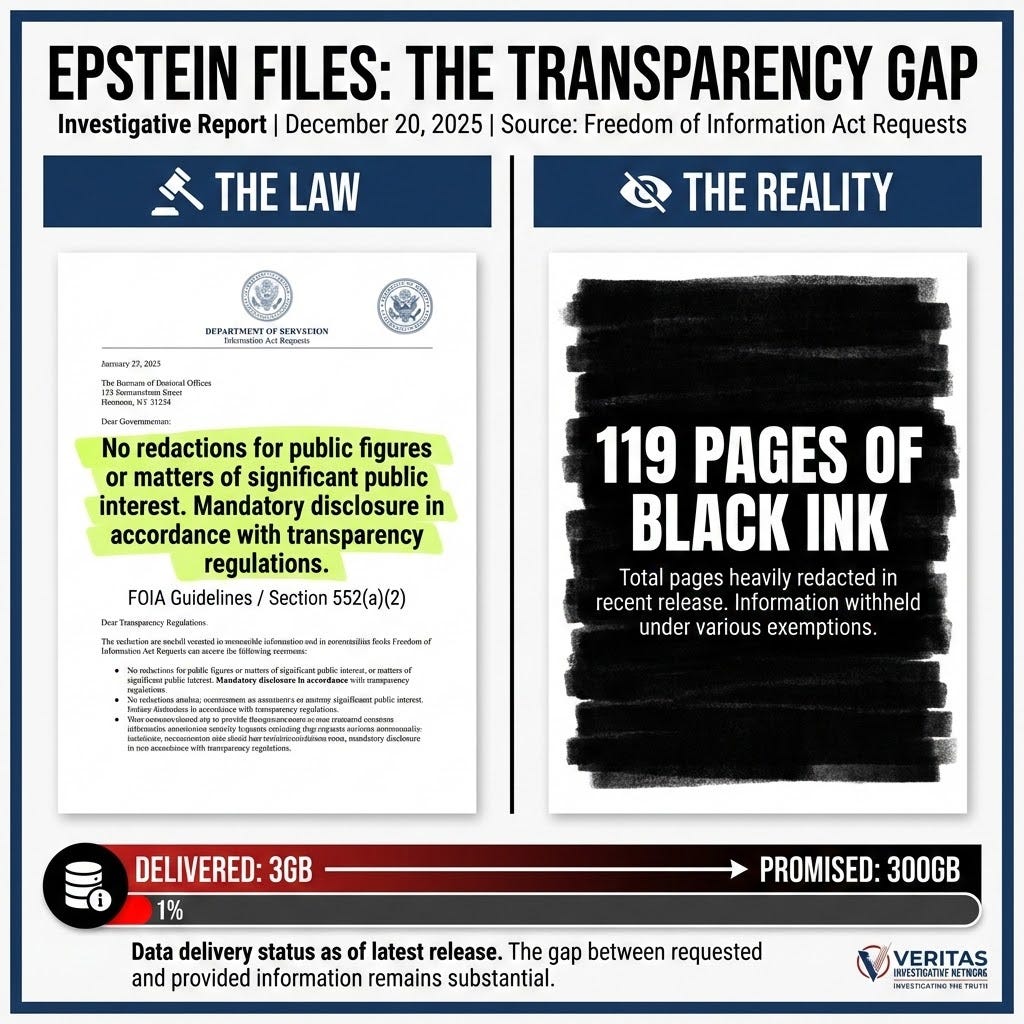
The DOJ then released those same grand jury materials as over 500 pages of solid black ink. No partial redactions. No names with context preserved. Complete informational blackout.
The DOJ went to court to argue that the Transparency Act overrode grand jury secrecy, only to then use “privacy” to reinstate that secrecy manually. They asked the court for the keys to the room, walked inside, and painted the windows black.
The law requires the DOJ to submit a justification report to Congress within 15 days of completing the release. It is hard to see any possible explanation for 119 pages of complete redaction. But as we’ll see, the DOJ’s “rolling release” strategy may be designed to ensure that the clock never starts.
The Scale of What’s Missing
Todd Blanche promised “several hundred thousand” files. The FBI’s own July memo described “more than 300 gigabytes of data and physical evidence” in their custody - nearly 100,000 pages plus 40 computers, 70 CDs, 26 storage drives, and six recording devices.
What landed Friday was roughly 3,900 files totaling around 3 gigabytes. For a case this size, 3GB is a rounding error. It’s the equivalent of a digital brochure when the law demanded the entire library.
The Legal Laundering Problem
Grand jury testimony, by its nature, contains information about perpetrators - names, conduct, locations, dates, corroborating details. It cannot plausibly be 100% victim-identifying information.
Yet the DOJ’s stated approach is to presume that anyone in proximity to Epstein might be a victim, and redact accordingly. As the DOJ stated in court filings: they’re “redacting the faces of women in photographs with Epstein even where not all the women are known to be victims because it is not practicable for the Department to identify every person.”
Apply that logic to testimony, and you get a mechanism for achieving prohibited ends through permitted means:
The law says: You cannot redact to protect government officials, public figures, or foreign dignitaries from reputational harm.
The law says: You can redact to protect victims’ privacy.
DOJ interpretation: Anyone might be a victim, therefore redact everything.
Practical effect: Government officials, public figures, and foreign dignitaries are protected from reputational harm.
This is legal laundering. They are running a prohibited outcome through a permitted exemption to make it appear compliant. By reclassifying politically exposed persons as “potential victims,” the DOJ has invented a new legal category that specifically negates the public figure protections Congress wrote into the Act.
The Questions That Need Answers
To Attorney General Bondi: You fought in three courts to unseal grand jury materials, arguing the Transparency Act required it. What changed between winning those motions and releasing 119 black pages?
To Deputy AG Blanche: The law requires written justification for redactions. Where is the justification for the grand jury document? What specific victim-identifying information appears on each of those 119 pages?
To the FBI personnel who spent 4,737 overtime hours on the “Special Redaction Project”: What were your instructions? Who provided the criteria for what to redact?
To Representatives Khanna and Massie: You wrote this law. Does the DOJ’s interpretation of “victim privacy” that includes presumptive victim status for anyone in proximity to Epstein match your legislative intent?
The Enforcement Gap
The Transparency Act has no penalty provision. Congress required disclosure but provided no mechanism to compel it. Khanna and Massie are now jointly threatening contempt, impeachment, and prosecution referrals. But contempt requires the House to act. Impeachment requires political will that may not exist. And prosecution referrals go to the same DOJ that’s doing the redacting.
The “rolling release” strategy compounds the problem. The law requires the Attorney General to submit a justification report to Congress within 15 days of completing the release, listing all categories that have been withheld and the legal basis for each redaction. By never declaring the release “complete,” the DOJ can argue that the clock never starts. They’re using one violation of the law - missing the 30-day deadline - to shield themselves from accountability mechanisms elsewhere in the same statute.
The one avenue with real teeth: Massie’s suggestion that a future DOJ could pursue obstruction of justice charges against current officials. That threat bypasses the current administration’s refusal to self-police, but it requires surviving until a future administration is willing to act.
A Note to Federal Employees Working on These Redactions
If you are among the FBI personnel who worked on the “Special Redaction Project” in July (logging 4,737 hours of overtime) or the recent December rush, you should understand your legal position.
You have a right to refuse. The Follow the Rules Act, signed into law during Trump’s first term, protects federal employees who refuse orders that would require them to violate a law, rule, or regulation. The Epstein Files Transparency Act is a law. If you were given redaction criteria that you reasonably believe violate it - for instance, instructions to redact material that could not plausibly be victim-identifying information - you are protected if you refuse.
You have a right to disclose. The Whistleblower Protection Act protects employees who disclose information they reasonably believe evidences a violation of law. You can disclose directly to Congress - specifically to the House or Senate Judiciary Committees - and that disclosure is protected by statute. You do not need to go through your chain of command.
You may have personal liability. “Just following orders” is not a complete defense. If you knew an order was unlawful and followed it anyway, you may bear individual responsibility. The law you were asked to implement is public. The prohibition on redacting for “reputational harm” is explicit. The question a future prosecutor might ask: did you know that 119 pages of grand jury testimony could not all be victim-identifying information?
This is not a comfortable position. The administration has threatened members of Congress - including Senator Elissa Slotkin and Representative Jason Crow for simply stating that service members must refuse illegal orders. The FBI is reportedly investigating them for saying what federal law already requires.
But that’s precisely why this matters. If the principle that federal employees must refuse illegal orders can be suppressed through intimidation, then the law means nothing. You are not alone, and you are protected. But only if you act.
What You Can Do
The enforcement gap in this law is real, but it’s not absolute. Congress passed this bill 427-1. That means your representative almost certainly voted for it. They have standing to demand compliance.
Contact your representatives. Tell them:
You expect them to hold the DOJ accountable for missing the 30-day deadline.
You expect them to demand the justification report required within 15 days of release completion.
You expect them to scrutinize that report for blanket “victim privacy” claims that cannot justify 119 pages of complete redaction.
You support Representatives Khanna and Massie in pursuing contempt, prosecution referrals, or impeachment if the DOJ continues to defy the law.
Find your representatives:
The law passed with near-unanimous support. Compliance should not be partisan. Remind your representatives that they voted for this, and their credibility depends on following through.
The survivors who waited decades for accountability deserve better than black pages. So does the public.
The question now is whether Congress has any remaining leverage to get what the law requires - or whether passing a law 427-1 means nothing when the executive branch decides not to comply.