

The children drew what they saw. The system seized the drawings.
In early February, ProPublica published letters from children detained at the South Texas Family Residential Center in Dilley, Texas — the only immigration detention facility in America holding families. The letters were smuggled out by a mother who hid them in her jacket during a room search.
A 7-year-old named Mia Valentina wrote: "I don't want to be in this place. I want to go to my school."
A 12-year-old named Ender, detained for 60 days, described going to the doctor and being told to drink more water — "and the worst thing is that it seems the water is what makes people sick here."
Children drew their families. They drew frowning faces. They drew stick figures behind wire fences.
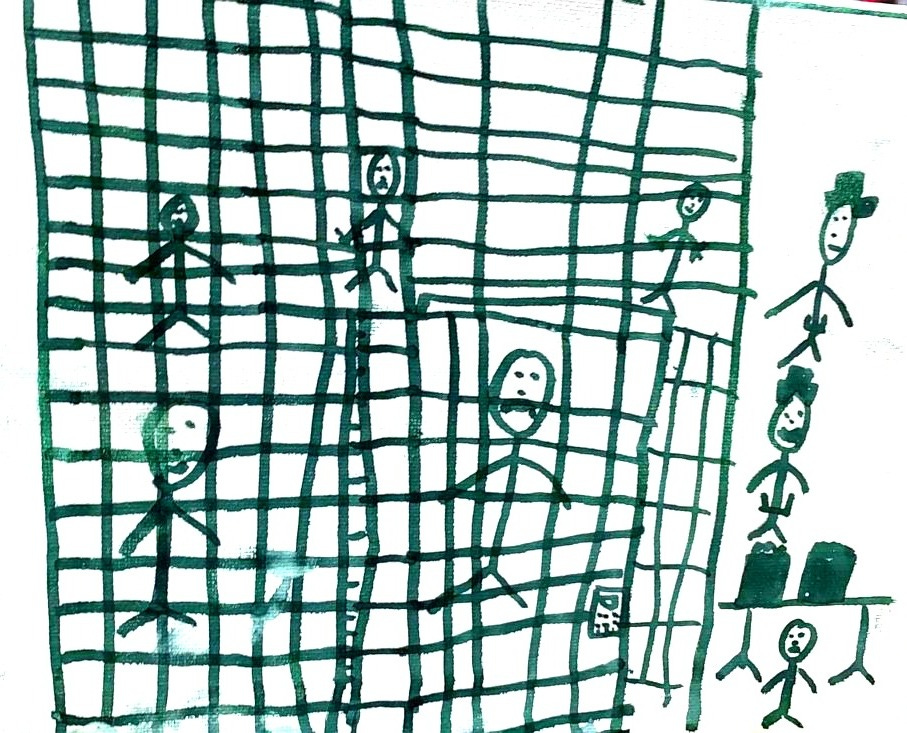
After the letters were published, guards began raiding the dormitories. They lifted mattresses, opened drawers, and confiscated crayons, colored pencils, drawing paper, and the children's letters. Fifteen-year-old Cariexis Quintero, who has the intellectual capacity of a 7-year-old, said through tears: "They threw away all of my drawings. My mom liked them."
Last week — March 20 — attorneys who represent all children in federal detention filed a new report with the court. Conditions at Dilley have not improved. Nearly 600 children were held longer than 20 days during December and January. The filing describes lights left on at night so children can't sleep. Children persistently ill. Lockdowns. Guards confiscating and destroying drawings during room searches.
And this: a 13-year-old girl tried to cut her wrists with a plastic cafeteria knife after guards took away her drawing materials. She was deported to Colombia last month.
In the same court, on March 13, attorneys representing the Department of Homeland Security filed their own account. Children at Dilley are housed in "safe, sanitary, and appropriate conditions." No placements on suicide watch. No reportable critical incidents.
Two testimonies. One from the children. One from the institution. The court holds both.
Closed systems produce abuse: concentrated power, removed accountability, silenced testimony.
What happened at Dilley is the architecture made visible. The children's letters are testimony — the most elemental form of witness. A child draws a frowning face behind a fence. That drawing is evidence. Not legal evidence, not forensic evidence — moral evidence. It's a human being telling the truth about what is being done to them, in the only language available to them.
The system's response to that testimony was not to address the conditions the children described. It was to confiscate the testimony.
That is what the theology of exposure looks like in reverse. When the prophetic tradition names the gap between what an institution claims and what it does — strip the whitewash, show the bones — the institution has two choices: change what it does, or silence the voice that named it.
Dilley chose silence. Guards entered children's rooms and took their crayons.
A 13-year-old girl tried to kill herself after they took away her drawing materials. She had been detained for nearly two months. She had found a worm in her food. She sometimes didn't receive her anxiety medication. When guards imposed a lockdown and blocked her from reaching her mother, she broke.
DHS filed a report saying there were no reportable critical incidents.
That gap — between the girl's wrists and the government's filing — is the whitewashed tomb. Beautiful on the outside. Full of bones within.
The question is never whether abuse occurs inside systems designed this way. The question is how long the darkness holds.
A lawyer named Angela Giuffrida has filed a FOIA request to recover the confiscated letters. She is doing what the tradition has always done: demanding that the testimony be returned. That the witness be heard. That the drawings of frowning faces behind wire fences be seen by everyone outside the walls.
The children wrote the truth. The system seized it. The work now is to get it back.
This post draws on reporting from the After the Arrest series, the Capture Cascade timeline (capturecascade.org), and ongoing detention monitoring. If this work matters to you, consider becoming a paid subscriber.
Previous coverage: After the Arrest: 7-Part Detention Series | The Darkness is Infrastructure | Making It Visible
You wrote “— moral evidence. It's a human being telling the truth about what is being done to them, in the only language available to them.” Yes! If there’s one thing that Church can do, it is site moral evidence as evidence. Thank you.
This is pure evil and cowardice. Heartbreaking, infuriating, and unAmerican.