

Springfield: The Next Front
A federal judge just blocked TPS termination. Springfield is preparing anyway
Last night, a federal judge blocked the Trump administration from terminating Temporary Protected Status for approximately 350,000 Haitians living in the United States. In an 83-page ruling, she found it “substantially likely” that DHS Secretary Kristi Noem made her decision out of “hostility to nonwhite immigrants.”

The legal victory should mean safety. It doesn’t.
Twelve thousand to fifteen thousand Haitians live in Springfield, Ohio—a city of 58,000. One in four residents. The largest concentration of Haitians in the Midwest. And despite Monday’s ruling, they’re still preparing for ICE to arrive.
This is the community Donald Trump and JD Vance targeted during the 2024 campaign with fabricated stories about immigrants eating pets. The lies triggered bomb threats, school evacuations, and a wave of white nationalist harassment that forced the city into lockdown.
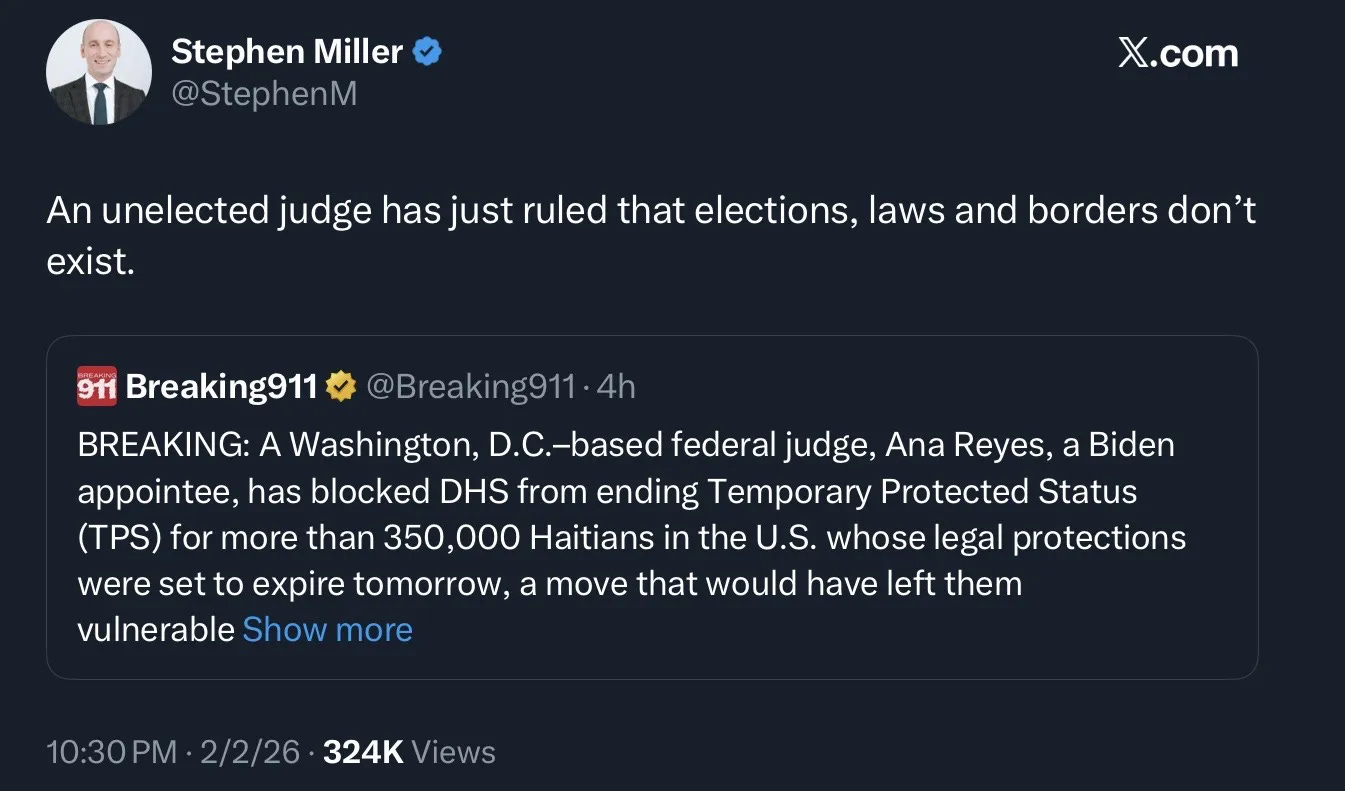
The administration that spread those lies has already shown it ignores court orders. In Minneapolis, ICE violated at least 96 judicial orders in January alone. Stephen Miller responded to Monday’s ruling by attacking the judge as “unelected” and declaring that she’d ruled “elections, laws and borders don’t exist.”
Springfield knows what comes next.
The Setup
Springfield wasn’t random.
Haitians began arriving after the Biden administration granted Temporary Protected Status in response to Haiti’s collapse into gang violence and political chaos. They came legally. They worked legally. They filled jobs in manufacturing and logistics that local employers couldn’t staff. City leaders said the Haitian community contributes to the economy and culture of Springfield.
“We are here because our country’s not doing well,” said Viles Dorsainvil, executive director of the Haitian Support Center in Springfield. “We are here to work, to raise our kids.”
Then the 2024 campaign needed a target.
The “eating pets” hoax originated in local social media posts and was amplified by Vance, then by Trump on the debate stage. Fact-checkers debunked it immediately. It didn’t matter. The point wasn’t truth—it was marking a community for later action.
Springfield’s city manager received death threats. Schools closed repeatedly for bomb threats. White nationalist groups descended on the city. For weeks, Springfield lived under siege.
“Since then, the fear has been there,” Dorsainvil said. It never left.
That was the preview.
The Trigger
Secretary of Homeland Security Kristi Noem determined in November 2025 that “there are no extraordinary and temporary conditions in Haiti that prevent Haitian nationals from returning in safety.”
This is the same Haiti where, according to the United Nations, gang violence killed over 8,100 people between January and November 2025. The same Haiti the State Department rates as “Do Not Travel”—its highest warning level.
“Haiti is currently facing one of the most severe security crises in the world,” said Dorsainvil, who came to the United States from Haiti in 2020. “Many families do not know where the next meal will come from. Markets are inaccessible due to gang control, supply chains are disrupted, and livelihoods have been destroyed.”
The determination wasn’t based on conditions in Haiti. It was based on what the administration wanted to do to Haitians in America.
Judge Reyes saw through it. But a court order is only as strong as the administration’s willingness to obey it.
What They’ve Seen
Springfield has watched Minneapolis.
They’ve seen the videos of Renee Good—a mother of three, shot through her windshield while turning away, labeled a terrorist before her body was cold.
They’ve seen Alex Pretti—an ICU nurse who cared for veterans, tackled while helping a woman off the ice, shot after his legally-carried weapon was already removed from his waistband, called an assassin by Stephen Miller.
They’ve seen 3,000 federal agents flood a city. Masked operations. Unmarked vehicles. Self-investigation after killings. Evidence seized before state investigators could examine it.
They’ve seen what “the largest immigration enforcement operation ever” looks like.
“The community is panicking,” Dorsainvil said. “They see the arrests on TV in other parts of the country and they don’t know what’s going to happen.”
And they know they’re next.
The Preparations
The community isn’t waiting.
The church network: Late last week, Governor Mike DeWine’s office sent word to “activate the churches.” The Nehemiah Foundation coordinates 28 churches and 114 background-checked volunteers ready to staff emergency hubs for children separated from parents.
Amy Willmann, the foundation’s point person, explained the message to Haitian families: “We want you to know they have a safe place to be until they’re reunified with you. We know that some of the parents will self-deport and take their children with them, some of them will take their children with them into detention. But we also know that some are already choosing to leave their children here.”
The scenario training: At Central Christian Church, 200 residents gathered for rapid response training on January 24—the same day Alex Pretti was killed in Minneapolis. They acted out scenarios: ICE entering a home, a business, a school, a church. They learned whistle codes: three short blasts for agents in the area, one long blast for a detention in progress.
Pastor Carl Ruby, whose congregation hosted the training: “We tried to distill everything that we’ve learned over the last year into one training session that was very specifically focused on what could happen in Springfield in the next couple of weeks.”
The long-term preparation: The Catholic charity St. Vincent de Paul has spent eight months urging Haitian parents to get U.S. passports for their American-born children—in case families need to self-deport together or flee to a third country. Kinship care and guardianship arrangements are being filed for worst-case scenarios.
The school district: Superintendent Bob Hill met with Governor DeWine on January 19. According to an internal email, he was told enforcement could begin February 4 and last approximately 30 days. Federal authorities have “a list of individual removal orders for Springfield residents, with the ability to detain others while the operation is underway.”
School staff have been instructed to require warrants and verify them with lawyers before granting ICE access. A document for families includes emergency planning guidance, immigration detention center locations, and contact information for organizations providing free legal help.
The Children
The numbers that keep Springfield’s organizers awake:
1,300: U.S. citizen children born to Haitian parents in Springfield since 2021. American citizens by birth, whose parents could still be targeted—court order or not.
1,500: Haitian children enrolled in Springfield City Schools—roughly 20% of the district. Vulnerable to enforcement actions targeting their families.
2,800: Children whose lives could be shattered by family separation.
This is what the church hubs are for. This is why Haitian parents are signing power of attorney documents. This is why the training scenarios included “child arrives home from school to an empty house.”
Some parents have signed caregiver affidavits designating legal guardians, hoping to keep their children out of foster care if they’re detained. “They’re not sending their kids to school,” Dorsainvil said.
The administration that designed family separation at the border is now running immigration enforcement nationwide. The architect of that policy, Tom Homan, has just taken personal command of the Minneapolis operation.
Springfield knows what Homan and Miller are willing to do to children.
The Legal Uncertainty
A federal judge in Washington, D.C., blocked the TPS termination Monday night. In an 83-page ruling, U.S. District Judge Ana Reyes found it “substantially likely” that Secretary Noem “preordained her termination decision and did so because of hostility to nonwhite immigrants.”
The ruling was devastating. Reyes concluded Noem’s decision was “arbitrary and capricious,” failed to consider “overwhelming evidence of present danger” in Haiti, and violated the Administrative Procedures Act by skipping required consultation with the State Department.
“Kristi Noem has a First Amendment right to call immigrants killers, leeches, entitlement junkies, and any other inapt name she wants,” Reyes wrote. “Secretary Noem, however, is constrained by both our Constitution and the APA to apply faithfully the facts to the law in implementing the TPS program. The record to-date shows she has yet to do that.”
The injunction means TPS remains in effect indefinitely during litigation. Work permits stay valid. Enrollees are legally protected from arrest and deportation.
But organizers aren’t counting on it.
Within hours of the ruling, Stephen Miller posted on X: “An unelected judge has just ruled that elections, laws and borders don’t exist.”
DHS spokesperson Tricia McLaughlin: “Supreme Court, here we come. This is lawless activism.”
This is the same delegitimization rhetoric the administration deploys before ignoring court orders. In Minneapolis, ICE violated at least 96 court orders in January alone, according to the chief federal judge in Minnesota.
Courts issue orders. The administration decides whether to obey them.
Dorsainvil is a plaintiff in one of the federal lawsuits challenging the TPS termination. He knows the stakes better than most: “This could be a matter of life and death,” he said, “because if people who fled Haiti are forced to return they could be attacked, kidnapped, tortured, and killed.”
Springfield is preparing as if the termination will proceed.
The Governor
Mike DeWine is a term-limited Republican in his final year in office. He has no more elections to win, no more political calculations to make.
He believes revoking TPS for Haitians is a mistake. He’s said so publicly: conditions in Haiti are “as dire as he’s ever seen.” He’s noted that approximately 1,000 Haitian children born in Springfield are legal U.S. citizens.
The framing is ambiguous. Back up to do what? Assist federal enforcement? Protect residents’ constitutional rights? Maintain order while agents operate?
DeWine says he’s gotten “mixed signals” on whether ICE will actually come. But he’s preparing either way.
That expectation has not been met in Minneapolis.
What Minneapolis Learned
The city that resisted had advantages Springfield doesn’t.
170 years of organizational infrastructure: Finnish socialist halls, the 1934 Teamsters strike, decades of labor organizing, the networks built after George Floyd. Springfield has churches and goodwill. It doesn’t have the accumulated capacity Minneapolis brought to the fight.
Scale: Minneapolis and St. Paul together have over 700,000 people. Springfield has 58,000. The organizational depth, the number of potential volunteers, the institutional resources—all are smaller.
Time under fire: Minneapolis had weeks of escalating operations before the first death. Springfield may face maximum intensity from day one—the administration learned from Minneapolis that slow escalation allows resistance to organize.
But Springfield has something Minneapolis didn’t: advance warning.
Minneapolis was learning under fire. Springfield has watched, studied, and prepared. The template exists. The question is whether it can be implemented fast enough, at sufficient scale, in a community that hasn’t been tested.
What Comes Next
Before Monday’s ruling, Springfield was told the operation could begin as early as February 4.
According to the school superintendent’s briefing, it could last approximately 30 days.
Federal authorities reportedly have a list of individual removal orders. But they also have “the ability to detain others while the operation is underway”—which means anyone perceived as Haitian is a potential target.
The Minneapolis pattern: targeting by appearance, not documentation. An ICE agent telling a detained U.S. citizen, “I can hear you don’t have the same accent as me.”
Springfield’s Haitian population is concentrated and visible. The community that revitalized the city’s economy is now the community marked for removal.
The Fear
“The folks are fearful,” Dorsainvil said. “They came here just to work and send their kids to school and be here peacefully.”
“The fear is turned up as high as it can go in the community,” said Marjory Wentworth, a poet and member of G92, the faith-based coalition supporting Springfield’s Haitians.
At a community meeting, a Black woman stood and said her 12-year-old grandson is “scared to death” walking to and from school—worried he could be racially profiled by agents looking for undocumented Haitians.
“I’m concerned about my family getting caught up in it because of our color,” said a resident who gave only her first name, Joyce. “I’m afraid to leave my house. This is the first time I’ve done so today.”
This is what the administration wants. The terror is the point. The empty streets, the shuttered businesses, the children kept home from school—that’s the policy working as designed.
Springfield’s resistance infrastructure is attempting something harder than Minneapolis faced: maintaining community function under terror, not just documenting abuses after they occur.
The Siege Continues
Minneapolis held through January. The walls didn’t break. The documentation infrastructure exposed lies faster than they could be told. The coalition maintained solidarity through two citizen deaths and sustained federal occupation.
Tom Homan has now taken personal command there—the architect of family separation, promising escalation.
And now, a second front waits.
Springfield, Ohio. Fifteen thousand Haitians. Twenty-eight churches. One hundred fourteen volunteers. A city that was already targeted once, preparing to be targeted again—regardless of what the courts say.
On paper, their legal status is protected. In practice, they’re waiting to see if the administration obeys the law.
“We pray for the best, but we prepare for the worst,” Dorsainvil said. “All that we can do is to make sure that we are mobilizing the community to help our brothers and sisters.”
The court has spoken. Now we find out if it matters.
Related Coverage
Understanding ICE’s Transformation:
The Four Thresholds: When Law Enforcement Becomes Paramilitary — How to recognize when a democratic institution has crossed the line into authoritarian control
Group Identity Targeting: From Individual Justice to Mass Roundups — How ICE abandoned constitutional policing for targeting based on appearance and location
The Deportation-Industrial Complex — Following the money through private prison corporations profiting from detention
The Pipeline That Built This:
The Architecture of Anonymous — How platform design became radicalization infrastructure
Destroy the Flood — How DHS recruitment completed the Gamergate-to-government pipeline
The Fastest Betrayal — How Latino voters realized they’d voted for their own deportation force
Actor Profiles:
Gregory Bovino: Portrait of an Enforcer — The Border Patrol commander running Operation Metro Surge
Kristi Noem: The New DHS — How the Secretary who terminated Haitian TPS operates
Tom Homan: Family Separation Architect — The man who just took personal command in Minneapolis
📊 Explore the Timeline: capturecascade.org/viewer
🔔 Subscribe: theramm.substack.com
Sources
On TPS Expiration and Springfield Context:
Spectrum News 1: “Ohio officials brace for possible ICE operation targeting Springfield Haitians” (February 2, 2026)
WYSU: “What’s Temporary Protected Status and other questions about ICE and Haitians in Springfield” (February 2, 2026)
NBC4 Columbus: “Springfield braces for possible ICE operation targeting Haitian immigrants” (January 31, 2026)
Ohio Statehouse News Bureau: “Gov. DeWine says he’s gotten ‘mixed signals’ on ICE action in Ohio” (January 30, 2026)
On Community Preparations:
Ohio Capital Journal: “Fear, faith and preparation as ICE closes in on an Ohio community” (January 30, 2026)
Ohio Capital Journal: “’The folks are fearful.’ Haitians living in Ohio may soon lose temporary protected status” (January 28, 2026)
WYSO: “Springfield residents learn rapid response training, expecting ICE agents to come to city” (January 28, 2026)
Signal Ohio: “Springfield prepares for an ICE raid it can’t confirm” (February 2, 2026)
Sojourners: “As ICE Closes In on Springfield, Here’s How Faith Groups Have Prepared” (February 2, 2026)
On Haitian Community Perspective:
Dayton Daily News: “Springfield resident part of federal lawsuit challenging end of protected status for Haitians” (January 2026)
WLWT: “Springfield’s Haitian community faces uncertainty over potential ICE operations” (January 2026)
PBS NewsHour: “Springfield’s Haitian migrants turn to faith amid deportation fears” (February 2026)
On Haiti Conditions:
Common Dreams: “ICE Expected to Flood Ohio Next Week and Round Up Haitians Stripped of Legal Status By Trump” (January 30, 2026)
On the Federal Court Ruling:
CBS News: “Judge blocks DHS from ending deportation protections for 350,000 Haitians” (February 2, 2026)
ABC News: “Judge blocks administration from ending TPS protections for more than 350,000 Haitian immigrants” (February 2, 2026)
The Daily Beast: “Judge Uses ICE Barbie’s Unpleasant Words Against Her in Scathing Ruling” (February 3, 2026)
The Hill: “Judge blocks Trump administration bid to end protections for Haitians” (February 3, 2026)
On Minneapolis Operations (for context):
Wikipedia: “Operation Metro Surge”
Wikipedia: “Killing of Alex Pretti”
NPR: “Internal review contradicts White House narrative of Pretti’s death” (January 27, 2026)
NBC News: “Two federal officers fired guns in Alex Pretti shooting, initial DHS report says” (January 28, 2026)
But they're eating dogs and cats! I hope ICE leaves Springfield alone.