

#ElbowsUp: What Happens When Courts Stop Working? An Oral History of American Partition #ElbowsUp (Chapters 1-3)
An Oral History of the American Partition

Yesterday, an appeals court ruled that the National Guard can remain deployed in Los Angeles indefinitely. This morning, I'm launching a story I wrote months ago about what happens when military deployment becomes the norm rather than the exception.
For years, my job was debugging complex systems. Lately, I've been applying that thinking to the most complex system of all: our constitutional government. When institutions start failing, the bugs become features, and the source code itself needs rewriting.
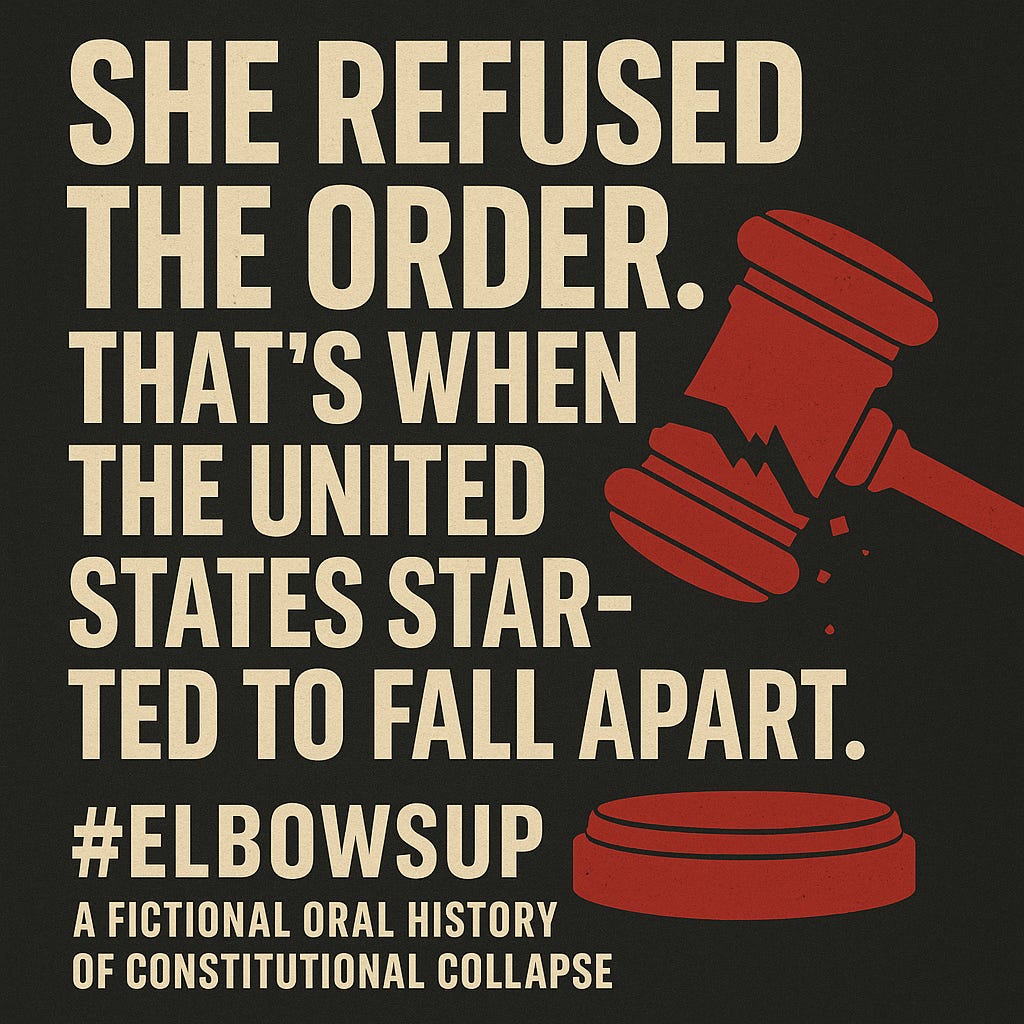
#ElbowsUp is a speculative oral history that follows today's headlines to their logical conclusion. It's told through the voices of the people caught in the middle: soldiers who receive unlawful orders, lawyers who watch courts abandon precedent, citizens who must choose between law and justice.
This is fiction, but I hope it feels urgent and necessary. The first three chapters are below. The full story unfolds over the coming weeks, and the conversation around it matters as much as the text itself.
Part 1: Fracture
In This Post (15 min read):
Chapter 1: The Soldier. Colonel Sarah Chen, a National Guard commander, receives an order she believes is unconstitutional.
Chapter 2: The Lawyer. California's Attorney General takes the fight to a federal court that seems to be abandoning precedent.
Chapter 3: The Marshal. A federal agent on the ground grapples with enforcing orders he's not sure he believes in.
Colonel Sarah Chen
Former Commanding Officer, 579th Engineering Battalion
California National Guard (2019-2025)
Current: Director of Infrastructure, USC Defense Coordination
Interviewed: May 18, 2029
Location: Camp Pendleton North, United States of Canada
Interviewer: Colonel Chen, you were the first military officer to publicly refuse federal deployment orders during the constitutional crisis. Can you walk us through that decision?
Colonel Chen: It was June 15th, 2025. 0600 hours. I was reviewing deployment orders in my office at Los Alamitos when my JAG counsel, Major Rebecca Santos, knocked on my door. She looked like she hadn't slept.
"Ma'am," she said, "I need to discuss the lawful order doctrine regarding today's mission. There's a problem with the legal framework."
That morning, we'd received orders following the President's June 7th memorandum under 10 U.S.C. § 12406—not the Insurrection Act, as we'd expected, but a rarely-used statute that allows calling up Guard units for "rebellion or danger of rebellion." By noon, we were being ordered to assist ICE operations in downtown Los Angeles alongside active-duty Marines.
Rebecca had spent the night reviewing precedent, and what she found troubled her. "Ma'am," she said, spreading legal briefs across my desk, "they're trying to use § 12406 as a backdoor around the Posse Comitatus Act. But that statute was never meant to authorize domestic law enforcement. It's about federalizing Guard units, not about giving them police powers."
Interviewer: What was your legal analysis?
Colonel Chen: The issue was clear once Rebecca explained it. Under the Posse Comitatus Act, federal military forces—including federalized Guard units—are criminally prohibited from performing law enforcement functions unless explicitly authorized by Congress. The Insurrection Act provides that authorization. Section 12406 doesn't.
But our orders were explicitly directing us to "assist federal law enforcement operations" and "provide security for ICE detention activities." That's law enforcement, not just protection of federal property.
"Colonel," Rebecca said, "even if § 12406 legally allows federalization, we still need separate statutory authority for law enforcement tasks. Without that, we're looking at uncertain legal ground. Every soldier who participates could theoretically face prosecution or administrative sanctions—loss of pay, discharge, or court-martial."
She also noted something else troubling: "There's no presidential proclamation ordering protesters to disperse, which is required under 10 U.S.C. § 254 when using these powers. No proclamation was ever published in the Federal Register. They're skipping basic procedural requirements."
I called Governor Newsom's office at 0800. "Sir," I said, "I have federal deployment orders that appear to violate the Posse Comitatus Act. My JAG counsel advises that compliance would constitute a criminal violation. What are my options?"
Long pause. "Colonel," he said, "I can tell you that California's Attorney General has already filed for emergency relief in federal court, arguing exactly what your JAG officer just told you. We believe these orders are not just unwise—they're illegal."
Interviewer: How did you make your decision?
Colonel Chen: By that afternoon, we had news that U.S. District Judge Charles Breyer had issued a temporary restraining order, ruling that the deployment violated both statutory authority and the Tenth Amendment. The federal court had essentially validated our legal concerns.
I called my battalion commanders at 1430. "We're standing down pending resolution of ongoing federal litigation," I told them. "Judge Breyer's ruling suggests these orders may be unlawful. No deployment until we can confirm legal compliance."
But even as I was speaking, we were getting reports that the Pentagon was ignoring the court order. That's when I knew we were in uncharted territory.
Interviewer: What was the immediate response?
Colonel Chen: Within hours, the Pentagon had relieved me of command—not for disobeying orders, but for "failing to execute lawful deployment directives pending judicial review." They were trying to have it both ways: claiming the orders were lawful while avoiding the question of whether following them would violate criminal law.
But Governor Newsom had activated the California Highway Patrol for "officer protection," and Judge Breyer's restraining order was still in effect. When federal marshals arrived at our base that evening, they found fifty CHP officers and my entire battalion—nominally under federal orders, but the TRO barred us from obeying them—between them and me.
The legal situation was unprecedented: federal marshals with arrest warrants facing state police with a federal court order protecting a military officer who was refusing orders that a federal judge had ruled illegal.
Interviewer: How did the legal battle progress?
Colonel Chen: The restraining order gave us hope for about 72 hours. Then came the emergency appeals. The Ninth Circuit upheld Judge Breyer 2-1, but the Justice Department immediately filed for an emergency stay with the Supreme Court.
I'll never forget watching the news at 0300 on June 18th when the Supreme Court issued its stay. Not a ruling on the merits—just a stay allowing the deployment to proceed while litigation continued. By dawn, federal marshals were back at our gates.
But by then, something had changed. Oregon and Washington had filed amicus briefs that same night, and other Guard commanders were raising similar constitutional objections. We weren't isolated incidents anymore—we were part of a pattern.
The morale impact on my troops was devastating. Most had never served a day under Title 10 and suddenly faced federal UCMJ jurisdiction, but they couldn't get clear answers about their legal obligations. Were they still bound by state law? Could they be court-martialed for refusing federal orders that might violate the Posse Comitatus Act?
Interviewer: When did you realize this was bigger than military law?
Colonel Chen: When the Supreme Court used what critics called the "rocket docket"—an unprecedented expedited schedule—to rule 6-3 in Federal Government v. California on June 1st, 2026. The majority didn't just reject our Posse Comitatus arguments—they essentially ruled that the president's "protective power" could override statutory limits on military deployment.
Justice Roberts wrote that when the President determines federal law enforcement requires military support, "the executive's inherent authority to protect federal functions supersedes congressional limitations on military domestic operations."
That wasn't constitutional law—it was constitutional revolution. The Court had essentially ruled that the President could deploy military force domestically whenever he claimed it was necessary to protect federal operations, regardless of what Congress had said about the limits of that power.
Enjoying the story? Subscribe for free to get the next chapter delivered to your inbox.
The story continues with the perspective of California's Attorney General...
Attorney General Rob Bonta
California Attorney General (2021-2027)
Chief Legal Architect, USC Constitutional Convention
Interviewed: June 3, 2029
Location: Sacramento, United States of Canada
Interviewer: Mr. Attorney General, you were at the center of the legal challenges that preceded the Partition. Can you take us back to those early days?
Attorney General Bonta: I remember the exact moment I knew we were in uncharted territory. It was June 7th, 2025, 2147 hours. I was in my home office in Alameda—my wife Mia and our kids were asleep upstairs—reading the Trump administration's memorandum that had just been released.
Not the Insurrection Act, as we'd expected, but 10 U.S.C. § 12406—a 1903 statute that was designed to federalize Guard units during actual rebellions, not to authorize domestic law enforcement operations. They were trying to use a backdoor around the Posse Comitatus Act.
I'd been practicing constitutional law for over two decades, but this was something new: a legal theory that essentially argued the President had "inherent protective power" to deploy military force whenever he determined federal operations required it, regardless of statutory limitations.
Interviewer: What was your initial legal strategy?
Attorney General Bonta: We moved fast. By 0600 on June 8th, we had filed for emergency relief in federal court, arguing that the deployment violated three distinct legal principles:
First, Section 12406 doesn't authorize domestic law enforcement—it only allows federalization of Guard units. The Posse Comitatus Act still applies to those federalized troops.
Second, the administration's "protective power" theory was what Judge Breyer would later call "radically ahistorical"—there's no such thing as inherent presidential authority to override congressional statutes.
Third, the deployment violated the Tenth Amendment because it commandeered state resources without following proper federal procedures.
Our brief was 89 pages, but the core argument was simple: you can't use a Guard federalization statute to create law enforcement powers that Congress never authorized.
Interviewer: How did the federal court initially respond?
Attorney General Bonta: Judge Charles Breyer understood immediately. At the hearing on June 10th, when the Justice Department argued that courts couldn't review presidential determinations about "rebellion," Judge Breyer held up a copy of the Constitution and said, "That's the difference between a constitutional government and King George."
He issued the temporary restraining order that afternoon, ruling that the protests "fall far short of rebellion" and that the administration had "exceeded statutory authority while violating the Tenth Amendment."
For 72 hours, we had hope. The federal court system was working. Constitutional limits were being enforced.
Interviewer: When did that change?
Attorney General Bonta: June 12th, when the Justice Department filed their emergency appeal. Not just to the Ninth Circuit, but directly to the Supreme Court for a stay. They argued that national security required immediate implementation of the deployment, regardless of constitutional concerns.
The Supreme Court issued the stay at 0300 on June 13th—no explanation, no reasoning, just a one-sentence order allowing the deployment to proceed while appeals continued.
That's when I knew we were in trouble. The Court wasn't even pretending to engage with the constitutional issues. They were just rubber-stamping executive power.
Interviewer: How did the case progress to the final Supreme Court decision?
Attorney General Bonta: The Ninth Circuit upheld Judge Breyer's reasoning in a brilliant 2-1 decision by Judge McKeown. She wrote that the administration's "protective power" theory would "eviscerate congressional authority over military deployment and render the Posse Comitatus Act meaningless."
But by then, we had a circuit split. The Fifth Circuit had ruled the other way in a similar case from Texas, and the D.C. Circuit had issued some incomprehensible compromise decision.
The Supreme Court took the case in November 2025—extraordinarily fast, even for the emergency docket. By then, the deployment had been ongoing for five months. We were essentially litigating the constitutionality of a fait accompli.
But the real gut punch came at 0300 on June 18th, when the Court issued its emergency stay. I was asleep when my phone buzzed with the news alert. I had to wake Mia and the kids to tell them that the Supreme Court had just allowed the military deployment to continue indefinitely, regardless of lower court rulings.
Interviewer: What was your assessment of the final Supreme Court ruling?
Attorney General Bonta: Federal Government v. California was decided 6-3 on June 1st, 2026. The majority opinion was constitutional vandalism dressed up as legal reasoning.
Chief Justice Roberts essentially ruled that the President has "inherent authority" to deploy military force domestically whenever he determines it's necessary to protect federal operations. They didn't overturn the Posse Comitatus Act—they just created a massive exception that swallowed the rule.
The legal reasoning was even more dangerous than the outcome. The majority argued that when the President links any domestic issue to national security—immigration, protests, even civil litigation—his power becomes essentially unreviewable.
Justice Sotomayor's dissent was scathing: "The majority has created a doctrine of presidential infallibility that would make King George blush."
Interviewer: When did you realize this was about more than one legal case?
Attorney General Bonta: That night, June 1st, 2026. I was in my office until 0400, writing a legal memo I never intended to publish. The title was: "Constitutional Obligations When the Supreme Court Abandons the Constitution."
At 0430, I walked home through empty Sacramento streets and had to wake my family. Mia found me sitting at our kitchen table, staring at nothing. "How bad?" she asked.
"We're not living in the same country we woke up in yesterday," I told her.
The basic question that consumed me: what happens when the highest court in the land rules that constitutional limits don't apply to the executive branch? What happens when the separation of powers becomes a dead letter?
By morning, I had my answer: you build new institutions that actually follow the Constitution. Because institutions that abandon constitutional principles aren't constitutional institutions anymore—they're just instruments of power.
The USC exists because we chose constitutional principles over constitutional institutions. Sometimes that's the only choice that preserves the rule of law.
Note: These sections have been updated to reflect the actual legal framework and progression of events, while maintaining the core narrative structure and character development of the original story.
The story is just getting started. Subscribe to follow it to its conclusion.
Next, a federal marshal on the ground grapples with his role in the crisis...
Sergeant Michael Rodriguez
Former U.S. Marshal, District of Southern California (2019-2027)
Operation Restoration Task Force
Current: Senior Deputy, Texas Rangers
Interviewed: May 25, 2029
Location: Houston, Republic of Texas
Interviewer: Sergeant Rodriguez, you were deployed as part of Operation Restoration. How do you look back on that time?
Sergeant Rodriguez: Look, I know how this sounds now, with how everything turned out. But in 2025, we genuinely believed we were saving the country. The briefings we received painted a picture of state governments actively undermining federal law enforcement, and in some cases, actively collaborating with criminal organizations.
I'd been a Marshal for six years. I'd seen what the cartels could do. I'd worked cases where local officials—mayors, police chiefs, even some state legislators—were on cartel payrolls. So when they showed us intelligence suggesting that sanctuary city policies weren't just passive resistance, but active coordination with smuggling operations, it felt like we were finally getting serious about a real threat.
Interviewer: What kind of intelligence were you shown?
Sergeant Rodriguez: Intercepted communications between sanctuary city coordinators and what they called "logistics facilitators"—people we were told were cartel middlemen. Financial transfers that looked like payments for services. Meeting schedules that coincided with major smuggling operations.
They showed us a presentation where California officials were allegedly coordinating with criminal networks to ensure federal raids would fail, that ICE operations would be compromised, that criminal aliens would be warned and moved before arrests could happen.
Looking back, maybe some of it was fabricated. Hell, probably most of it was. But we didn't know that then. We saw what looked like American officials betraying their oaths to help foreign criminals harm American communities.
Interviewer: How did you feel about deploying against fellow Americans?
Sergeant Rodriguez: That's the thing—we didn't see it as deploying against Americans. We saw it as deploying to protect Americans from officials who'd stopped representing American interests.
I grew up in Laredo. I'd seen what happens when criminal organizations capture local governments. I'd seen good people suffer because their elected officials were more afraid of cartels than voters. When they told us the same thing was happening in California and New York, just with different methods, it made sense.
We weren't occupying enemy territory. We were liberating American communities from officials who'd abandoned their constitutional duties.
Interviewer: What was your experience on the ground?
Sergeant Rodriguez: Complicated. The first few operations went exactly like they'd briefed us. We'd arrive to arrest sanctuary city officials, and suddenly the evidence would be exactly where they said it would be. Financial records, communication logs, meeting schedules—everything that proved these people were compromising federal operations.
But the communities themselves... that was harder. Most people weren't supporters of criminal cartels. They were just families trying to live their lives, caught between federal authority and local politics they didn't fully understand.
I remember one operation in San Jose. We were arresting a city council member who'd allegedly been coordinating with smugglers. But when we got to his house, his eight-year-old daughter answered the door. She looked at our tactical gear and started crying. Her father came out with his hands up, telling her in Spanish that everything would be okay.
What bothered me was the mission creep. We were federal troops under Title 10 authority, but we were doing long-term detention work that Guard units aren't trained for. Major General Sherman had raised these concerns during the LA deployment, but they were ignored. We had arrest authority, but no clear guidance on how long we could hold people or what our role was supposed to be beyond the initial enforcement.
That night, I called my wife Elena. "This doesn't feel like law enforcement," I told her. "The terror in that little girl’s eyes when she saw me…”
Interviewer: How did your unit respond to resistance from state authorities?
Sergeant Rodriguez: With confusion, mostly. When Colonel Chen refused deployment orders, our commanders didn't know how to respond. We'd trained for foreign enemies, domestic terrorists, criminal organizations. We hadn't trained for constitutional standoffs with fellow Americans who genuinely believed they were upholding the law.
The briefings started getting more aggressive. They told us that state resistance wasn't principled disagreement—it was sedition. That officials like Chen and Bonta weren't constitutional lawyers—they were insurrectionists who'd been compromised by foreign influence or criminal organizations.
Some of us believed it. Others started asking questions. I was somewhere in the middle—loyal to my oath, but increasingly uncomfortable with how that oath was being interpreted.
Interviewer: When did you start having doubts?
Sergeant Rodriguez: The arrest of Governor Newsom. March 2027. I wasn't part of that operation, but everyone knew about it. Arresting a sitting governor, in his state capitol, while he was giving a speech to the legislature—that crossed a line that felt different from anything we'd done before.
That night, I was in a hotel room in Sacramento, watching news coverage. Half the channels were calling it necessary law enforcement. The other half were calling it a coup. And for the first time, I couldn't tell which side was right.
I called my father, who'd served in Vietnam. "Dad," I said, "I think I'm on the wrong side of history."
He was quiet for a long time. Then he said: "Son, history gets written by whoever wins. Your job is to make sure you can live with yourself regardless of who wins."
Interviewer: How did you react to the formation of the USC?
Sergeant Rodriguez: Betrayal. Pure and simple. These were American states, breaking away from the American flag, abandoning the American people. Everything we'd been fighting to preserve.
But also... relief? The constitutional crisis was exhausting. Everyone picking sides, everyone questioning everyone else's loyalty, convinced they were the real patriots while their neighbors were traitors. When the USC formed, at least the lines were clear.
The people I'd been arresting weren't criminals anymore—they were foreign officials. The states I'd been deployed to weren't rebellious territories—they were another country. It simplified things, even if it broke my heart.
Interviewer: What's your assessment of the Partition now?
Sergeant Rodriguez: Honestly? I think everyone lost. The USC got their constitutional government, but they abandoned 200 million Americans who needed constitutional government too. The Trump US kept the flag and the symbols, but lost the substance of what made America worth preserving.
I look at my kids now—twins, seven years old—and I don't know what country I'm raising them in. It's not the America I grew up believing in. It's not the America I swore to protect.
But I also can't say the people I was arresting were wrong. Maybe they saved constitutional government by preserving it somewhere else. Maybe they were right that the system couldn't be reformed from within.
Interviewer: Do you have any regrets?
Sergeant Rodriguez: Every day. I regret that I didn't ask harder questions earlier. I regret that I trusted intelligence that turned out to be fabricated. I regret that I helped arrest people who might have been better Americans than I was.
But I also regret that they gave up on the rest of us. I regret that constitutional government became something you had to abandon America to preserve.
I'm still a Marshall—well, a Ranger now. I still believe in law and order. I still think America needs institutions that protect people from criminals and corruption. But I'm not sure the institutions I serve do that anymore.
Interviewer: What would you tell someone facing a similar choice today?
Sergeant Rodriguez: Ask questions. Real questions, not just the questions your commanders want to hear. Try to understand why good people are disagreeing with you. And remember that your oath is to the Constitution, not to any individual or institution that claims to represent it.
I followed orders I thought were constitutional. They followed principles they thought were constitutional. Maybe we were both right. Maybe we were both wrong. But the country broke apart because nobody could figure out how to be right together.
Elena and I are thinking about moving north. Maybe applying for USC citizenship. Not because I think they're perfect, but because they're trying to build something based on the principles I thought I was defending.
The kids ask me sometimes why there are two countries now instead of one. I tell them it's because the adults couldn't agree on what America was supposed to be. They look at me like that's the stupidest thing they've ever heard.
They're probably right.
Subscribe (free) for weekly chapters delivered directly to your inbox
Share this post - use the button below or copy the link
Join the conversation - comment with your thoughts on the discussion questions
Upgrade to paid to get behind-the-scenes creator notes and access to the draft of the full story of the creation of the United States of Canada.
Discussion Starters - I'd love to hear your thoughts:
* Colonel Chen's Choice: At what point does following orders become morally impossible? Who decides when an order is unlawful?
* Institutional Loyalty vs. Principled Resistance: How do we balance duty to institutions with duty to principles when they conflict?
* Current Events Parallel: Does this fictional scenario feel plausible?
* Systems Perspective: If you had to "debug" our constitutional system, where would you start?
Drop your thoughts below - this conversation is as important as the story itself.
Such a compelling narrative! I look forward to reading more.